Rush Limbaugh Responds To KKK Comparison at Easter Church Service
Entry #4,476



The time is now 12:52 am
You last visited
June 10, 2026, 10:04 am
All times shown are
Eastern Time (GMT-5:00)

High gas prices cut into driving habits — and Obama’s approval rating
Steven Mufson and Jon Cohen
Washington Post
Monday, April 25, 10:26 PM
Soaring gasoline prices are biting into household incomes and nibbling at Americans’ fuel consumption — and support for President Obama, according to a Washington Post-ABC News poll.
About six in 10 respondents said they had cut back on driving because of rising fuel prices, and seven in 10 said that high pump prices are causing financial hardship.
Obama, like previous presidents in times of high oil prices, is taking a hit. Only 39 percent of those who call gas prices a “serious financial hardship” approve of the way he is doing his job, and 33 percent of them say he’s doing a good job on the economy.
The Energy Information Administration said Monday that gas prices climbed last week to $3.88 a gallon, up 81 cents since the start of the year. That is the highest pump price since August 2008, before the financial meltdown.
Evidence of motorists’ hardships is littering the roads. AAA says the number of motorists running out of gas has been surging. John Townsend, a spokesman for the automobile association, said that cash-strapped members “are pushing the envelope” and that emergency gas deliveries to stranded members jumped nationwide, including by 40 percent in the District.
That sort of hardship could slow Obama’s reelection campaign. The Post-ABC poll shows that 60 percent of independents who say they’ve been hit hard by surging gas prices also say they definitely won’t support Obama in his bid for reelection.
In a hypothetical matchup with former Massachusetts governor Mitt Romney, the top GOP performer in the Post-ABC poll, Romney wins by 24 points among the independents who have taken a severe financial hit because of gas prices, and the president is up 7 percentage points among other independents.
At a fundraiser in Southern California last week, where pump prices are the highest in the country, Obama acknowledged the political peril of high gas prices. He said, “My poll numbers go up and down depending on the latest crisis, and right now gas prices are weighing heavily on people.”
He tried to show that he feels motorists’ pain. “I admit, Secret Service doesn’t let me fill up the pump anymore,” he said. “But it hasn’t been that long since I did.”
The poll also shows the stubborn nature of gasoline consumption and the difficulty of weaning the country off its dependence on imported oil. About a quarter of all Americans say they would not alter their driving habits until prices, which are about $1 a gallon higher than a year ago, climb an additional $1.10 or to more than $5.
Although gasoline prices are just a quarter of a dollar short of their all-time record of $4.11 for a gallon of regular set in July 2008, the Energy Information Administration forecast this month that gas consumption would average about 9.3 million barrels a day over the peak summer driving season, a 0.5 percent increase over last summer.
“Population growth and a recovering economy contribute to gasoline consumption growth,” the EIA said, adding that high gas prices and better fuel efficiency standards would dampen demand. Consumption of diesel fuel is expected to climb 2.3 percent because of higher industrial output and trade.
“I think the evidence is strong that people are not very price responsive and that there are no magic thresholds where the effect changes suddenly,” said Severin Borenstein, a professor at the University of California Berkeley business school and director of the California Energy Institute.
In 2008 when prices last spiked, motorists carpooled, households drove the more efficient of their cars when a choice was possible, and many people opted for public transportation. But the impact was slight.
Borenstein says the drop in consumption was 3 to 4 percentage points. “That’s a pretty small demand response when the price of gasoline nearly doubles,” he said. Moreover, he said, “this was happening in context of a giant recession, so there were income effects as well.”
Christopher Knittel, a professor of applied economics at the Massachusetts Institute of Technology, said that “consumers are less responsive today than in the past, especially when compared to the 1970s.” With the growth of families with two income earners and other social changes, motorists are less likely to regard their day-to-day driving as discretionary.
But, Knittel said, “if prices continue to be high, they start to change what cars they buy, and manufacturers start to change the cars they offer. So it really depends on the time frame.”
Knittel said that the increase in gasoline prices is partly a result of the recovering economy. “One of the reasons gas prices are high is that we are coming out of the recession,” he said. “So it’s sort of bittersweet. The economy is getting strong, but it’s hurting our pocketbook.”
That could circle around and undercut the recovery. Peter Morici, a professor at the University of Maryland’s business school, estimates that the spike in gas prices since September translates into a 5 percent cut in discretionary income and that Americans “will be eating fewer restaurant meals, wearing fewer new clothes, curtailing summer vacation plans, and postponing furniture purchases and home improvements.”
In the Post-ABC poll, 12 percent of people who consider gas prices a financial hardship said they had slashed spending elsewhere.
The telephone poll was conducted April 14 to 17 among a random national sample of 1,001 adults. The margin of sampling error is 3.5 percentage points.
Polling manager Peyton Craighill contributed to this report.
Gwinnett couple conquers $83,000 of credit card debt
5:53 am April 26, 2011
Henry Unger
AJC
This is a good-news column about conquering debt, brought to you by Courtney and Michael Wacker of Lawrenceville.

Courtney and Michael Wacker
(Photo by Robin Henson)
Buried in a credit card hole and staring at financial disaster, the Wackers managed to whack about $83,000 in principal and interest in a little over five years.
How they got into the mess — fairly typical — and how they climbed out — determination and good advice — can be an example for consumers facing similar messes.
“We had so many cards full of so much stuff that we started just paying the minimum. That was the big trap,” said Courtney Wacker, a 46-year-old former teacher who works in educational testing.
It wasn’t the house or car payments that got the Wackers in trouble. It wasn’t the two kids. It was the plastic.
“You charge it,” Courtney Wacker said. “It’s the American way. I’m going to pay it off later.” Only “later” didn’t come until after the mountain of debt was about to crush them. As their credit scores kept falling, the interest rates on the nine credit cards shot up to as high as 32 percent. By paying the minimum each month, the Wackers were looking at about 30 years to get out from under the load.
Since they didn’t want to be in their 70s before the cards were paid off and since they were opposed to filing for bankruptcy, the Wackers sought help from CredAbility, the nonprofit group formerly known as the Consumer Credit Counseling Service of Greater Atlanta.
First, the nine cards were cut up. Then, a CredAbility counselor went through their budget, put them on a debt management plan and contacted their creditors. The counselor was able to negotiate a critical change — the interest rate on the debt was cut to 3 percent from 32 percent.
“That’s what saved us,” Courtney Wacker said.
Each month, the Wackers paid a figure they’ll never forget — $1,456, which included a $50 monthly fee to CredAbility.
To hit that monthly target, they had to completely change their spending habits. No impulse buys. No meals out. No vacations, other than driving to see family or friends. No expensive Christmas or birthday gifts. Handmade gifts instead.
“We had to adjust to strictly cash, even to pay for gas and food,” said Michael Wacker, a Georgia Power maintenance specialist. “Once that first year got by, we were OK.”
Did it affect your relationship, which began back in high school?
“You have to be able to work together,” Michael Wacker, 46, said. “You have to be patient with each other.”
They had to establish priorities, which were essentially living expenses, plus one other thing — continuing to pay for the kids’ competitive swimming activities. Everything else was eliminated.
As their debt was being retired, their credit scores steadily rose to 750 from the 500 neighborhood. Now, with all of it paid off, the Wackers still plan all of their spending, and pay with cash. They literally have a written, five-year plan detailing how they’re going to tackle many home-improvement projects they plan to do themselves.
Any advice for others?
“If you can’t pay for it, you can’t get it,” Courtney Wacker said. “If you fall into the credit-card trap, don’t wait long to get help.”
Disgraced cop Emmanuel Tavarez pleads guilty to robbing drug dealers; faces 30 years in prison
John Marzulli
DAILY NEWS STAFF WRITER
Monday, April 25th 2011, 6:40 PM

Emmanuel Tavarez's wife wept in the courtroom as the 8-year-veteran of the force admitted he sold out his badge.
"I participated in the robberies of drug dealers," Tavarez said. "I was a lookout."
Tavarez, 31, copped to the crimes that could put him away until he's a senior citizen on the eve of jury selection for his trial in Brooklyn Federal Court.
Defense lawyer Raymond Colon said Tavarez made the decision based on the "crushing weight" of the evidence. The cop has no plea deal with the government.
"It's a tragic situation for the Tavarez family," Colon told The Daily News. "This was a young man with a lot of promise."
Tavarez was a promising professional baseball prospect before he joined the NYPD. When he was arrested last May he was only days away from being approved for a tax-free pension for a line-of-duty injury that would have been worth well over $1 million over his lifetime.
But the cop's greed led him to associate with criminals who used Tavarez's status as a cop to carry out the armed robberies. The stolen drugs were later sold and the profits split.
Tavarez said he personally participated in stickups in Connecticut and Long Island.
Prosecutors said Tavarez used his badge to falsify search warrants, provided NYPD raid jackets and other paraphrenalia to the crew and restrained one victim with handcuffs.
Tavarez denied that he loaned his service gun to a crew member.
He faces 30 to 40 years in prison when he's sentenced in July by Federal Judge Sandra Townes.
Members of the NYPD Internal Affairs Bureau informed the lawyer that Tavarez was terminated from the force as a result of his guilty plea.
Hairy heist at beauty supply firm
Carlos Sadovi
Tribune reporter
12:50 p.m. CDT, April 25, 2011


The last time crooks broke into Jay Han's beauty supply store on the Near West Side, they made off with cash.
Early Easter morning, some enterprising thieves made off with more valuable loot: Nearly $80,000 worth of human hair.
The break-in occurred early Sunday morning in the rear of the Beauty One, 616 W. Roosevelt Rd. and was captured on videotape.
Han, 52, who has had the shop in the same location for more than six years said he believes the thieves knew just how valuable the hair could be on the black market.
The tresses, which are packaged with brand names like Indi-Remy, Saga Hair and Bohyme Hair, are used to braid hair and for hair extensions especially in the African-American community, said Han.
He said the thieves targeted the most expensive brands which are more durable and comfortable and left behind poorer quality synthetic locks. They also made off with other hair products.
"They know, because they have a wife and they know what they do to beautify their hair styles and how they invest their money to buy hair," said Han. "They knew that there is a difference between synthetic hair."
According to videotaped surveillance outside of his shop, a white van drove up to the back of the store and three men struggled with a heavy steel door that was sealed tight with two deadbolt locks. According to the video the men used a metal pry bar to open the door.
As two of the men went into the shop, one man stood outside and acted as a lookout. Within seconds, the men were back out of the shop with large plastic bins full of the packages of hair and other items including wigs with natural hair, he said. He said a wall stacked with the premium items was cleared out. He said each of the packs of hair is worth about $200.
While a security alarm inside the shop went off, he faulted police for not showing up quickly enough and letting the men make off with their loot.
"They didn't touch money, they did better," Han said.
Here is the Link: http://www.chicagotribune.com/videobeta/d7f93b33-2508-4a8c-89e4-b3dd06a4285f/News/Surveillance-video-Hair-heist-at-Beauty-One
NFL lockout has been lifted
Judge Susan Nelson grants request of players for an injuction that forces NFL teams to continue football operations.
Sam Farmer
LA Times
4:10 PM PDT, April 25, 2011
The NFL lockout has been lifted.
Judge Susan Nelson of the U.S. District Court in Minneapolis granted the request of the players for an injunction that forces NFL teams to continue football operations.
Nelson's ruling gives the players an early victory in their battle with team owners over a new collective bargaining agreement in the $9 billion business. Owners locked out the players after negotiations broke down on March 11 and the players decertified their union.
Nelson could have granted the injunction but issued a stay to keep the lockout in place until the appeal. However, she decided not to stay the decision, meaning the league must lift the lockout immediately and cannot put it in place while it waits for a decision from the Eighth Circuit Court of Appeals in St. Louis.
The NFL issued a statement saying it will appeal Nelson's ruling.
"We will promptly seek a stay from Judge Nelson pending an expedited appeal to the Eighth Circuit Court of Appeals. We believe that federal law bars injunctions in labor disputes. We are confident that the Eighth Circuit will agree. But we also believe that this dispute will inevitably end with a collective bargaining agreement, which would be in the best interests of players, clubs and fans. We can reach a fair agreement only if we continue negotiations toward that goal."
The appellate court has the ability to overturn a ruling when it finds a mistake in the application of the law.
"It means that the NFL is going to go back to business as usual with the old system," said attorney Jerome Stanley, a longtime player agent. "The parties will eventually sit down and negotiate a new system."
DeMaurice Smith, head of the decertified NFL Players' Assn., said he was "happy for our players and for our fans. Today, those who love football are the winners."
Reactions from players was just as positive.
"Today's ruling is a win for the players and for the fans that want to see a full NFL season in 2011," Giants defensive lineman Osi Umenyiora said. "The lockout is bad for everyone and players will continue to fight it. We hope that this will bring us one step closer to playing the game we love."
Times staff writer Lance Pugmire contributed to this report.
Sunday, April 24, 2011 at 10:02 PM
Man makes a rowboat his home under the 520 bridge
William Kaphaem and his dog, Lulu, live in an aluminum 14-foot rowboat in a foot of water under the Highway 520 bridge in Seattle.
Erik Lacitis
Seattle Times staff reporter
Under the concrete pillars of the Highway 520 bridge, anchored in a foot of water, William Kaphaem and his dog, Lulu, live in an aluminum 14-foot rowboat.
They seem to have found peace at the edge of the Arboretum.
Kaphaem has rigged the boat so it's covered by a 20-by-18-foot brown plastic tarp, with a few feet of headroom. It seems to blend in with the muddy bottom by the bridge posts of the Montlake Boulevard East exit.
He has a close-up view of the wildlife there.
"Beavers, muskrats, wood ducks, eagles — lots of eagles — blue herons, green herons, mallards, Canada geese, cormorants, kingfishers, raccoons, coyotes, now and then," says Three Stars about what he's seen.
Among the some 2,400 homeless counted living outside this January by the Seattle/King County Coalition on Homelessness, his is one of the more unusual living arrangements.
The way he sees it, he and Lulu didn't have much choice: the streets or here.
"I've got a lot of stuff. I didn't want to schlep it around town like some tramp," says Three Stars. "I've got more dignity than that."
Early in 2010, after the death of the elderly owner of the West Seattle home in which he was renting a room for $150 a month, Three Stars had to find cheap lodging.
He lives on $636 a month SSI, the government's program to help the aged and disabled.
That allows him to take the bus to the Safeway on Capitol Hill and shop for food for himself and Lulu.
When he leaves for a few hours, Three Stars puts on waders and anchors the boat maybe 10 feet from shore. Once, he knew that somebody rustled through his boat. Another time, somebody untied it and it drifted off.
Now, if somebody wants to mess with the boat, they'll get soaked in 3 feet of water.
Three Stars qualifies for SSI because, as he explains it, he's got the kind of attention-deficit disorder "in which like I had 40 jobs in two years, and I got fired in all of them ... Burger King, grocery store ... sometimes I can't shut my face."
He doesn't mind sharing his life's details, such as growing up in Massachusetts and Florida under less than nurturing family situations.
A vocation that did suit him was as a street musician.
He learned to play the guitar on his own, and traveled around the country. He ended up here in 1980, he says.
"This hippie in New Orleans told me about Seattle, said they wouldn't persecute you for playing in the streets," says Three Stars.
Some of you might recall seeing Three Stars and Lulu on the sidewalk outside of Pacific Place in downtown Seattle.
He would play the guitar and sing a lot of country standards. Lulu, which Three Stars says is a mixture of wolf and husky, and is closing in on 10 years, would keep him company. They'd earn a few extra bucks.
He stopped playing last year, he says, because of tendinitis. "My wrist was falling asleep," he says.
For a number of years, says Three Stars, he even lived a kind of family life, fathering a daughter, living with her mother (now deceased, he says) in motels and subsidized housing.
He says his daughter now is 24 and that he keeps in touch with her. He says she's going to let him use her apartment to wash up and do laundry.
Under the bridge, he doesn't bother anyone; and those who know about him leave him alone.
State Department of Transportation workers working near the bridge one day recently just shrugged him off.
But John Moriarty, the 13th Coast Guard District assistant division chief for waterways management, when asked about a boat such as Three Stars', says, "Now we'll have to check him out."
They have concerns. For example, what is Three Stars doing with his waste? wonders Moriarty.
Three Stars says he either bags it and puts it in the trash bins "that go to a landfill" or uses lavatories.
Moriarty says that also, "We want to make sure he's safe."
So far, Three Stars seems to be.
He just wants to be left alone.
He says, "It's a very peaceful experience."
You wouldn't even know there was somebody inside unless you yelled over the noise of the rumbling cars and trucks above, "Hey, Three Stars!"
Kaphaem, 51, says he has Mohawk ancestry and so he prefers to be called by that name, which reflects the outdoors.
Hearing your voice, Kaphaem — Three Stars — will lift up the tarp that serves as his cocoon.
"Actually, a lot of light gets through," he says.
Inside his rowboat home, he sometimes reads, and often listens to a baseball game or KIXI-AM easy-listening classic hits on a battery-powered radio with a headset. He handrolls cigarettes with filters.
Across a couple of the benches, he has laid a sheet of plywood that serves as the backing for his bed.
He has a Coleman lantern and a stove, making sure to ventilate when heating some soup or frying up fish. For cold nights and days, he wears three or four layers of clothing.
In the boat, he has five spinning rods, and, using worms, manages to catch perch, bass and the occasional trout. He has a collapsible trap for catching crawdads, which he plans to use in the summer when he rows up Lake Washington to the Sammamish Slough.
LINK TO PHOTO GALLERY:
http://seattletimes.nwsource.com/html/photogalleries/localnews2014866819/
401(k) plans: 'The Smartest 401(k) Book You'll Ever Read' offers insight
401(k) plans can often be a better deal for your employer than for you. This book gives advice on navigating a 401(k) system that's sometimes unfair.
Trent Hamm
posted April 25, 2011 at 10:34 am EDT
Every Sunday, The Simple Dollar reviews a personal finance or other book of interest. Also available is a complete list of the hundreds of book reviews that have appeared on The Simple Dollar over the years.
About a year ago, I reviewed Daniel Solin’s The Smartest Retirement Book You’ll Ever Read and concluded that it was a strong book to read if you’re a high income earner and concerned about retirement.
It was good enough, though, that I decided to keep an eye out for Solin’s other books and read them over time. Last month, I picked up Solin’s The Smartest 401(k) Book You’ll Ever Read in an effort to take a deeper look at the realities of retirement plans that many people use.
Does the book offer any real advice, or does it just rehash information that can easily be found elsewhere? Let’s dig in and find out.
Rules for All Investments
Solin’s real focus in this book, much like his other books, is that a successful investor focusesheavily on minimizing costs. You shouldn’t worry so much about short term return numbers on the investments you’re looking at. Look instead at things like expense ratios and the fees you’re charged. You’ll find that investments like index funds tend to stand out from the pack. Also, Solin urges people to avoid the hype for various funds out there in the financial media and instead focus on just the numbers.
401(k)Plans: Rigged to Rob Your Nest Egg
Here, Solin argues (quite well) that 401(k)s are fraught with risks. For starters, your employer often chooses a401(k) plan that benefitsthem the most, not the plan that benefits you the most. In short, you’re usually going to get the short end of the stick with your work plan compared to what you could get on an open market. Companies know you’re restricted in your401(k) choices, so they offer up relatively poor investment choices inside those plans. They’re expensive, fraught with conflicts of interest, and can make things even worse if you make poor investment choices.
How to Beat a Rigged 401(k)System
So what’s the solution? Lobby your employer for better options. Minimize the portion of your investment portfolio that’s actually in a401(k) plan. Look for the lowest cost investments in the plan. Invest only enough to get all of your employer’s match, then look for other options. In short, don’t buy into the idea that your only way to save for retirement is through whatever options the “advisor” at work tells you to invest in your401(k).
The Care and Feeding of Your IRA
What do you do if you don’t invest in your401(k)? Solin recommends opening up an IRA, either a Roth or a Traditional depending on whether your income is low enough to qualify you for a Roth. An IRA gives you much more control over your retirement savings, as you get to choose the investment house rather than relying on what your employer has chosen. Look for an investment house that has very low fees (preferably none) and a diversity of investments that have very low expense ratios. I use Vanguard, for example.
403(b) Plans and Annuities – They Make 401(k)Plans Look Good!
403(b) plans are much like 401(k)s, but they’re often even worse than 401(k)s because the problems with 401(k)s are exacerbated with 403(b)s. With 401(k)s, employers are involved but are often looking for a balance of minimizing costs for themselves and providing good options for their employees. With 403(b)s, employers often don’t care at all about the investment plans, leaving greedy investment houses to offer up poor investments to subscribers. Not only that, 403(b) plans often push people into annuities, which are terrible options for such retirement plans.
Alternatives to Traditional Retirement Plans
What can you do? Solin offers a few options here. The most interesting, in my eyes, was to invest in thingsoutside of retirement plans that return a consistent income, never mind the tax burden. He mentions lifetime annuities as one example.
Is The Smartest 401(k) Book You’ll Ever Read Worth Reading?
This book does a great job of making the case that your401(k) plan at work is likely not your best investment option. If you take the ideas in this book and use them to evaluate your401(k) or 403(b), you might not like what you find.
From there, though, Solin’s ideas for alternatives are spare and vague. He does offer some ideas, but he doesn’t offer an abundance of specific pointers to follow.
If you’re willing to use this book as a starting point for evaluating your retirement options and learning more, The Smartest 401(k) Book You’ll Ever Read is a very good choice. It is not, however, a one-stop-shop for everything you need for retirement planning.
Sarah Palin is getting less media attention than she used to
Perhaps Sarah Palin's advisers have a right to be upset about the former Alaska governor's media coverage these days. As FiveThirtyEight's Nate Silver reports, press coverage of Palin has been on the decline in recent months. She's now getting only one-fifth the press coverage she did last fall.
Silver notes that Palin's declining coverage coincides with her falling polling numbers among voters but also with the rise of Donald Trump's potential candidacy. But what Silver doesn't mention—and could also be a factor—is Palin's decision to take a lower profile in the aftermath of what even some of her employers derided as her flubbed response to media coverage of January's deadly Tucson shooting.
While she's continued to make occasional appearances on Fox News, Palin has declined several high-profile speaking gigs in recent months, including a coveted spot at February's Conservative Political Action Conference in Washington. Instead, she stuck around Alaska, where she attended her husband Todd's Iron Dog snowmobile race. She also packed her schedule with paid speeches, most of which were closed to the press.
In March, she edged into the spotlight again, traveling to India, where she gave a paid speech at business conference in New Dehli but largely eschewed reporters. She tacked on a visit to Israel, where she met with Prime Minister Benjamin Netanyahu but, again, gave little access to the media.
Palin's most high-profile foray back into the public eye was her speech last weekend at a Wisconsin tea party rally, which apparently didn't garner the press coverage one of her advisers had hoped for.
Silver's implication is that media coverage boosts a 2012 candidate's stock with GOP voters--which is no doubt a possibility given Trump's surge in recent presidential polls. But the candidate who gets more media coverage doesn't always win. Just ask John McCain about the 2000 GOP primary or Howard Dean about the 2004 campaign. More than anything, the stats seem to be more of an indication of the volatility of the Republican electorate and the wide open GOP field heading into next year's primary.
1:26 PM Apr 22, 2011
Sherene Tagharobi
Wilx News 10
There are almost as many "no smoking" signs at Sparrow Hospital as there are cigarette butts along its campus. The hospital banned smoking on site years ago, and whether or not people listened, it's taking the next step in its anti-tobacco policy.
"Anybody who tests positive for tobacco or nicotine products will not be able to gain employment at Sparrow," said John Berg, a Sparrow marketing executive.
Lucky for current employees who smoke, that only goes for new hires starting May 1, 2011. Still, those we talked to--smokers or not--didn't like it.
"See that's crazy to me, your freedom of choice...that's why I live in America," said Jacob McPhail, a non-smoking employee.
"I don't think that's fair. I think if they don't want them smoking on campus that's fine but I think what you do on your own time should be up to you," said employee Michael VanDussen, who does smoke.
The sparrow campus has been smoke free since 2007 and the signs are everywhere to prove it. But there's also proof the policy isn't always enforced. We found a pile of cigarette butts swept up just feet from a no-smoking sign outside the building, not to mention, people coming and going for smoke breaks there too.
LINK TO VIDEO:
www.woodtv.com/dpp/health/Smokers-wont-be-hired-at-Sparrow-Hospital
Drill baby drill won't lower gas prices
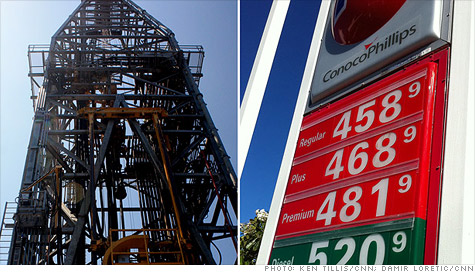
The United States simply doesn't have enough oil to move world markets. Plus, any increase would be offset by OPEC.
Steve Hargreaves
Senior Writer
April 25, 2011: 5:37 AM ET
NEW YORK (CNNMoney) -- Every time gas prices reach record highs the call goes out for more oil drilling. This year it's no different.
"The Gulf is ready to get back to work to help create jobs and lower gasoline prices," Washington Republican Doc Hastings, head of the House Natural Resources Committee and a big proponent of more drilling, said last week.
The problem is this: While increased oil and gas drilling in the United States may create good-paying jobs, reduce reliance on foreign oil and lower the trade deficit, it will have hardly any impact on gas and oil prices.
That's because the amount of extra oil that could be produced from more drilling in this country is tiny compared to what the world consumes.
Plus, any extra oil the country did produce would likely be quickly offset by a cut in OPEC production.
"This drill drill drill thing is tired," said Tom Kloza, chief oil analyst at the Oil Price Information Service, which calculates gas prices for the motorist organization AAA. "It's a simplistic way of looking for a solution that doesn't exist."
According to a 2009 study from the government's Energy Information Administration, opening up waters that are currently closed to drilling off the East Coast, West Coast and the west coast of Florida would yield an extra 500,000 barrels a day by 2030.
The world currently consumes 89 million barrels a day, and by then would likely be using over 100 million barrels.
After OPEC got done adjusting its production to reflect the increased American output, gas prices might drop a whopping 3 cents a gallon, the study said.
"More production from anywhere would tend to lower prices," said Adam Sieminski, chief energy economist at Deutsche Bank. "But the amount that we're talking about domestically, it wouldn't move gas prices from $4 a gallon to $3."
In fact, more domestic oil is just what we've been seeing and gasoline prices are still going up.
Including liquids from natural gas, biofuels and other products that are all used to make gasoline, the United States now produces 9.7 million barrels of oil a day, according to EIA. That's the most oil this country has pumped in 20 years, and puts it just behind Saudi Arabia and Russia as the world's top producer.
Since 2005 production has been steadily rising. The United States now produces about a million and a half more barrels today than it did six years ago. Over this same time period oil hit a record $147 a barrel.
Oddly, it's largely because of high prices that this new production is possible. The deepwater drilling, shale rock extraction and other techniques used to increase production are pricey endeavors.
It's been a bounty for those that work in the oil and gas industry. In the last ten years the industry has added 2 million jobs, said Rayola Dougher, senior economic advisor for the American Petroleum Institute. The industry now employs over 9 million Americans.
These are well-paying jobs. People can earn $15 to $20 an hour right out of high school. With a just a few years experience, $60,000 a year is possible. Petroleum engineers and others with advanced degrees easily clear six figures.
It's also been good for oil companies. Thanks to lower taxes, companies generally make much more money on a barrel of oil produced in the United States than they do from North Sea or Middle East crude.
Dougher said that if all federal land was open to oil drilling -- not just offshore but Alaska's wildlife refuge and all federal land in the West that isn't a national park -- the country could produce an extra 2.8 million barrels of oil a day by 2025.
Being that she represents the oil industry, Dougher gave the idea a hard sell.
She said it would create another 500,000 jobs, add $150 billion each year to government coffers and shave a significant chunk off the country's foreign trade deficit.
But one argument she didn't make was lower prices.
"How would that play out in the market, what impact would that have on prices," she said, "we just don't know." 
