truesee's Blog

I'd Support Obama's Tax Cuts Package If I Had No Other Choice

 
Sam Stein

HuffPost Reporting

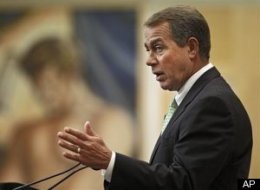
John Boehner: I'd Support Obama's Tax Cuts Package If I Had No Other Choice


House Minority Leader John Boehner (R-Ohio) on Sunday offered one the sharpest indications to date that the GOP may be willing to allow the Bush tax cuts for the rich expire at the end of this year.

In an interview on CBS's "Face the Nation," the Ohio Republican said that he would support an extension of the Bush tax cuts just for those making under $250,000 a year if that was the only vote he'd get. His preference remained a full extension for all rates.

Bob Schieffer: "I want to make sure I heard what you said correctly: You're saying that you are willing to vote for those middle class tax cuts, even though the bill will not include ... extending the tax cuts for the upper bracket American."


Rep. Boehner: "Bob, we don't know what the bill's going to say, alright? If the only option I have is to vote for those at 250 and below, of course I'm going to do that. But I'm going to do everything I can to fight to make sure that we extend the current tax rates for all Americans."


This is a step further in terms of political compromise than that offered by Senate Minority Leader Mitch McConnell, who has said he'd be open to a temporary extension for all the Bush tax cuts (as opposed to, say, an indefinite extension).

The remarks were a bit of a game-changer in the context of the Bush tax cuts debate -- granting the Obama administration the green light to push forward with legislation that would allow rates for the wealthy to revert to Clinton-era levels. It also puts the spotlight on moderate Democrats who have, so far, pushed for keeping rates the same across the board.

"This means President Obama won't be able to blame R's for 'holding the middle class hostage,'" said a top Republican aide in Congress. "He, and the media, will have to face the fact that the real problem is among the Democrats."

But while Boehner may have made news for hinting that the GOP won't oppose the President's tax cut policy, he also offered a fairly substantive admission later in the interview. Explaining why he thought it would be bad economics to let the tax cuts for the wealthy expire, the minority leader acknowledged that only 3 percent of small business members would be affected by the hiked up rates.

Bob Schieffer: Let me just say this: The Joint Committee on Taxation, which is a non-partisan body, says that only 3 percent of those small business people -- you keep talking about all the small business people that are going to get taxed -- only 3 percent would be affected by that. Do you quarrel with that figure? Is that a right figure, or a wrong figure?

Rep. Boehner: Well it may be 3 percent, but it's half of small business income, because obviously the top 3 percent have half of the gross income for those companies that we would term "small businesses." And this is why you don't want to punish these people at a time when you have a weak economy. We need them to reinvest in their business.

Entry #3,150

Obama uses Bush plan for terror war includes tactics he criticized


Eli Lake

The Washington Times

10:28 p.m., Thursday, September 9, 2010

Obama uses Bush plan for terror war

Includes tactics he had criticized

Mugshot

Michael Hayden


As the ninth anniversary of the 9/11 attacks approaches, much of President Obama's counterterrorism policies and his understanding of executive power closely hew to the last administration, which he criticized as a candidate for the White House.

On issues ranging from the government's detention authority to a program to kill al Qaeda terrorist suspects, even if they are American citizens, Mr. Obama has consolidated much of the power President George W. Bush asserted after Sept. 11 in the waging of the U.S. war against terror.

The continuities between the two administrations were evident this week, when the U.S. Court of Appeals for the 9th Circuit dismissed a lawsuit that five former U.S. detainees brought against a subsidiary of Boeing Co. known as Jeppesen Dataplan.

The former detainees alleged that Jeppesen Dataplan facilitated their transport to U.S. and foreign prisons, where they were tortured. The Obama Justice Department, like the Bush Justice Department before it, urged the court to dismiss the case on grounds that state secrets would be disclosed in litigation.

In a 6-5 decision, the court ruled in favor of the federal government.

"It can fairly be said that the Bush administration made torture the law of the land and the Obama administration is making impunity for torture the law of the land," said Ben Wizner, the American Civil Liberties Union (ACLU) attorney who represented the plaintiffs in the case.

To be sure, Mr. Obama has made some changes to Mr. Bush's counterterrorism policies. On his first day in office, Mr. Obama signed an executive order that shuttered the CIA's enhanced interrogation program, which critics say practiced torture against senior al Qaeda suspects.

In an executive order, Mr. Obama also closed the secret "black site prisons," though he kept open temporary facilities where suspects could be taken before being sent elsewhere. Mr. Obama also pledged to close the Guantanamo Bay, Cuba, prison by the end of his first year in office, but that facility remains open.

For now, U.S. policy is not to send any Yemeni prisoners back to Yemen, where high-profile jail breaks have resulted in the freeing of senior members of al Qaeda. More than half of the 180 prisoners at Guantanamo Bay are from Yemen.

"Obama has defined this as a war, just like George Bush did. He gets great marks for the macro statement, but some of the other rhetoric confuses that fact as well," Michael Hayden, Mr. Bush's last CIA director, said in an interview Thursday.

Mr. Hayden cited as an example the Justice Department reading Miranda rights to Umar Farouk Abdulmutallab, the Nigerian national who is accused of trying to blow up a flight from Amsterdam to Detroit on Christmas Day.

Overall, Mr. Hayden said, there is more continuity than divergence between the Bush and Obama administrations' approaches to the war on terror.

"You've got state secrets, targeted killings, indefinite detention, renditions, the opposition to extending the right of habeas corpus to prisoners at Bagram [in Afghanistan]," Mr. Hayden said, listing the continuities. "And although it is slightly different, Obama has been as aggressive as President Bush in defending prerogatives about who he has to inform in Congress for executive covert action."

The White House declined to comment for this report.

However, the Obama administration has specifically said it differs from the Bush administration in that Mr. Obama has rejected the view that the executive branch has inherent wartime authorities that allow it overrule laws passed by Congress.

Nonetheless, the Obama administration has asserted that a congressional resolution authorizing force against al Qaeda gives the president the right to detain, kill and abduct suspected terrorists all over the world.

In addition, Mr. Obama threatened to veto an amendment to the Intelligence Authorization bill for 2011 if it contained a provision that requires the full intelligence committee, instead of its chairman and ranking member, to be informed about covert action.

Sen. Christopher S. Bond, Missouri Republican and vice chairman of the Senate intelligence committee, said Mr. Obama has hampered the CIA in some areas by delegating more counterterrorism authority to the Justice Department.

But Mr. Bond also acknowledged similarities with the Bush administration.

"I appreciate his administration supporting the state secrets doctrine in court proceedings," he said. "It is important that people not be allowed to get military and intelligence secrets through a lawsuit. That is important. There are other policies which he has continued, some of them I cannot speak officially about, but they have been effective in taking out terrorists in the Pakistani areas."

Fran Townsend, a former homeland security adviser to Mr. Bush, said: "On counterterrorism policy, they found they agree with much of what we did, but that fact is politically inconvenient to acknowledge."

It's not just former Bush officials who see continuity on counterterrorism in the Obama administration.

An ACLU report issued in July found: "On a range of issues including accountability for torture, detention of terrorism suspects, and use of lethal force against civilians, there is a very real danger that the Obama administration will enshrine permanently within the law policies and practices that were widely considered extreme and unlawful during the Bush administration."

The continuities also extend to homeland security.

"From a homeland security point of view, the points of continuity are striking and the points of departure are minor," said Stewart Baker, a former policy chief for the Department of Homeland Security and author of "Skating on Stilts," a legal defense of much of the new policies in the global war on terror.

"The Obama administration is, if anything, even more enthusiastic about using travel information to identify potentially risky travelers," he said. "They are actually more aggressive about the use of the 'no-fly' list than the last administration, after the Christmas Day bombing incident."

In one of the most significant areas of continuity, the Obama administration also has largely based much of its war authorities on the Sept. 14, 2001, congressional resolution authorizing the use of military force against the individuals and groups responsible for the Sept. 11 attacks: the Authorization for Use of Military Force, known as the AUMF.

Obama administration lawyers have argued the AUMF gives the government the authority to detain terrorism suspects indefinitely and conduct targeted killings in countries where the United States has not declared war.

Jack Goldsmith, a former head of the Justice Department's office of legal counsel who rolled back some of the legal justifications for Bush-era enhanced interrogation, said: "The AUMF is the main font of authority for both detention and targeting activities in Afghanistan and for Somalia and Yemen. That was also the main font of authority for the Bush administration."

The continuity also extends to the federal government's surveillance powers.

"There is no better example of Obama's continuity with Bush than last year's Patriot Act reauthorization debate," said Julian Sanchez, a scholar at the Cato Institute who specializes in privacy issues. "The administration had to launder its amendments through Republicans ... to kill his own party's proposed checks on surveillance power."

As a candidate, Mr. Obama at first opposed changes to the Foreign Intelligence Surveillance Act (FISA), but then voted for the amendments. Those amendments in some ways codified surveillance programs Mr. Bush ordered after Sept. 11 that drew intense criticism from Democrats, including Mr. Obama, when they were first disclosed in the New York Times in 2005.

"The FISA amendments act gave National Security Agency on balance far more authority than George Bush ever gave it," a retired senior U.S. intelligence official told The Washington Times.

Mr. Bond said: "I congratulate [Mr. Obama] on following the law passed on a bipartisan basis. I am pleased he is continuing to use the authorities provided in the FISA legislation. If the people who don't want us to listen in on terrorist communications are unhappy, that shows he is on the right path."

Mr. Obama's government also continues, according to some advocates, to overclassify government information, despite the high-profile release last year of some Justice Department memos justifying water-boarding and sleep deprivation and a 2004 CIA inspector general report analyzing the agency's enhanced interrogation program.

"The continuities are far more prominent than the departures. One could make the same point incidentally not just with respect to 9/11 policies, but with respect to the whole Cold War security apparatus," said Steven Aftergood, director of the project on government secrecy at the Federation of American Scientists. "National security classification policy continues to follow the pattern established by Truman and Eisenhower."

Mr. Aftergood added: "Fundamentally, we are persisting on a security path that was charted in radically different circumstances more than half a century ago."

Entry #3,149

Those born on September 12th

     September 12th people are concerned with the literal meaning of both the written and spoken word. Not only are they interested in words, but also in language and communication of various types. It could be said that they greatly enjoy having an attentive audience. This is not to imply that they are particularly effusive types they understand the importance of restraint. Indeed, most born on this day are actually quiet and private people. Overtly active and hardworking, they prefer on occasion to let their actions speak for them instead of the word which they value so highly.

     Ethical issues are of the greatest importance to September 12th people and those who have public or administrative careers are not only capable of cleaning up the act of an organization or social group but also of managing to keep it running in a smooth and efficient, albeit unconventional , way.

     September 12th people are not always easy to get in touch with. Both in the workplace and at home they tend to hide out, surrounding themselves with all sorts of defense mechanisms which make it hard to get through to them.

   Although expansive in their thoughts and projects, those born on this day are much too pragmatic and realistic to be blind optimists. There is a strongly measured, even cynical streak running through them that despises all forms of over enthusiasm and hysterical behavior.

     Those born on the 12th of the month are ruled by the number 3(2+1=3. Those ruled by the number 3 frequently rise to the highest positions in their sphere. They can also be dictatorial and should be aware of this. Those ruled by the number 3 like to be independent, and may feel the urge to relinquish positions of authority for greater freedom.  They can just grow tired of directing others.

Advice: Try to develop a decent personal life for yourself. Moderate your workaholic tendencies if you want to live longer. Don’t make promises you can’t keep or bite off more than you can chew.

Strengths:  Honorable, witty and fearless

Weaknesses:   Dry, cynical and closed.

Born on This Day:  Henry Hudson, H. L. Mencken, George Jones and Barry White

This Day In History:  Sep 12, 1940 Lascaux cave paintings discovered

Near Montignac, France, a collection of prehistoric cave paintings are discovered by four teenagers who stumbled upon the ancient artwork after following their dog down a narrow entrance into a cavern. The 15,000- to 17,000-year-old paintings, consisting mostly of animal representations, are among the finest examples of art from the Upper Paleolithic period.

Famous Inventions:   1961 Patent #3,000,000 was granted for an automatic reading system for utilities to Kenneth Eldredge.

Entry #3,148

Statistics shows record increase in Americans in poverty

Statistics expected to show record increase in Americans in poverty


Hope Yen and Liz Sidoti 
Associated Press
September 11, 2010
 

WASHINGTON -- The number of people in the U.S. who are in poverty is on track for a record increase on President Barack Obama's watch, with the ranks of working-age poor approaching 1960s levels that led to the national war on poverty.

Census figures for 2009 -- the recession-ravaged first year of the Democrat's presidency -- are to be released in the coming week, and demographers expect grim findings.

Advertisement
Interviews with six demographers who closely track poverty trends found wide consensus that 2009 figures are likely to show a significant rate increase to the range of 14.7 percent to 15 percent.

Should those estimates hold true, some 45 million people in this country, or more than 1 in 7, were poor last year. It would be the highest single-year increase since the government began calculating poverty figures in 1959. The previous high was in 1980 when the rate jumped 1.3 percentage points to 13 percent during the energy crisis.

Among the 18-64 working-age population, the demographers expect a rise beyond 12.4 percent, up from 11.7 percent. That would make it the highest since at least 1965, when another Democratic president, Lyndon B. Johnson, launched the war on poverty that expanded the federal government's role in social welfare programs from education to health care.

Demographers also are confident the report will show:

>>Child poverty increased from 19 percent to more than 20 percent.

>>Blacks and Latinos were disproportionately hit, based on their higher rates of unemployment.

>>Metropolitan areas that posted the largest gains in poverty included Modesto, Calif.; Detroit; Cape Coral-Fort Myers, Fla.; Los Angeles and Las Vegas.

The 2009 forecasts are largely based on historical data and the unemployment rate, which climbed to 10.1 percent last October to post a record one-year gain.

The projections partly rely on a methodology by Rebecca Blank, a former poverty expert who now oversees the census. She estimated last year that poverty would hit about 14.8 percent if unemployment reached 10 percent. "As long as unemployment is higher, poverty will be higher," she said in an interview then.

A formula by Richard Bavier, a former analyst with the White House Office of Management and Budget who has had high rates of accuracy over the last decade, predicts poverty will reach 15 percent.

That would put the rate at the highest level since 1993. The all-time high was 22.4 percent in 1959, the first year the government began tracking povertyIn 2008, the poverty level stood at $22,025 for a family of four, based on an official government calculation that includes only cash income before tax deductions.

Entry #3,147

Robber positively identified had 'GET MONEY' shaved in hair

Police: Suspect advertised intentions with haircut

Man suspected of robbery had 'get money' shaved in hair

CASEY MCNERTHNEY
SEATTLE PI STAFF

A robbery suspect was arrested after police say he was identified by his haircut: The phrase "GET MONEY" shaved onto one side of his head.

Larry Shawn Taylor, 18, now has a room at King County Jail and a Sept. 13 arraignment, where he is expected to enter a plea. 

At about 10:15 p.m. on Aug. 23, two young women were parked beneath a stoplight on the north side of the 3000 block of Northeast 137th Street. The driver was sending a text message.

Taylor allegedly walked by when the passenger's window was down.

"Taylor stepped up to the open window and pointed a pistol at (the victim)," Seattle Police Detective David Clement wrote in a probable cause document. "He said, 'Empty out your (expletive) wallet! Give me your (expletive) money!'

"The victim was very afraid, so she took $310 out of her purse and gave it to Taylor."

He then ran to a vehicle that had stopped and backed up, police said. The car drove away on 32nd Avenue Northeast.

Police say Taylor wasn't hard to identify.

The victim described him as a black man in his 20s, with a small build of 5-foot-5 or 5-foot-6, who had small ears that were possibly deformed or folded over. Victims said the suspect wore a red and black checkered zip-up jacket and blue jeans.

"He had 'MOB' shaved into one side of his hair and 'GET MONEY' on the other," Clement wrote. "He had 'GET' tattooed on his right hand and 'MONEY' on his left hand. He had flame designs on both forearms. He held the pistol with his right hand."

Clement sent out two e-mails to department personnel about the case. He noted the suspect hung out at Little Brook Park -- a notorious park known for criminal activity. Some police refer to it as Little Beirut, and neighbors have tried to deter criminals there, organizing potlucks and outdoor movie nights.

The day of the second e-mail, court documents Officer Sarah Mulloy said she stopped a suspect matching that description several times and told of another officer who had recently written him a ticket.

Another detective, Mel Britt, searched records using tattoo information as search criteria and found Taylor's name and date of birth.

That night, Mulloy, who patrols Lake City, stopped a red four-door Toyota Camry for reckless driving. She recognized Taylor, got backup and arrested him, according to court documents.

A red and black checkered shirt or jacket was viewed in the backseat. Taylor was taken to police headquarters. A search warrant document stated a loaded pistol was found in the Camry.

"Upon my contact with Taylor, I noticed that Taylor had writing shaved into his hair -- 'GET MONEY' on one side and I couldn't read the other side," Clement wrote. "I asked him where he got his hair done and he told me at the barbershop on Lake City Way."

The victim had told the detective the suspect might have gotten his hair styled at the barbershop in the 13700 block of Lake City Way Northeast.

"I noticed that Taylor's ears are deformed in a way -- the tops fold down," Clement wrote. "Taylor had 'GET' tattooed on the top of his right hand and 'MONEY' tattooed on the top of his left hand. He had flames on his left forearm."

The victim identified him as the person who robbed her at gunpoint, according to the probable cause document.

Taylor, who is from Oregon, has no known convictions, according to court documents. He's being held on $100,000 bail.

Entry #3,146

Father-in-law has shot son-in-law before

Detective: Father-in-law has shot son-in-law before


Vickie Welborn

The Times 

September 9, 2010


MANSFIELD – The man shot Wednesday night by his father-in-law has been shot by the same man before - and with the same gun, authorities said today. 

Alvin Gentry, 39, of the 900 block of Daw Road, is recovering in LSU Hospital in Shreveport of a through-and-through gunshot wound to his back. The injury is non-life threatening, DeSoto sheriff’s Cpl. Dusty Herring said. 

Gentry’s 74-year-old father-in-law, Alvis McKinney, who lives next door to Gentry, is in the DeSoto Detention Center charged with aggravated battery, DWI-third offense and an assortment of traffic violations. 

McKinney told investigators in a statement given after his arrest Wednesday night that he did not realize he had shot Gentry, Herring said. The shooting occurred as Gentry and his wife, who is McKinney’s daughter, were arguing outside of their home in the Carmel community. 

“McKinney went out there and told (Gentry) to leave. He popped off a round” as a warning shot, Herring said. More words were exchanged between the three then McKinney pointed his .22-caliber pistol in Gentry’s direction and fired another shot. 

“That’s when the victim went down and that’s when (McKinney) realized he shot him,” Herring said. 

Gentry was flown by Life Air to the Shreveport hospital for treatment. McKinney left the scene in a pickup truck and was arrested less than an hour later by a state trooper who located his vehicle on U.S. Highway 84 at the intersection of state Highway 522. McKinney’s impairment was evident to the trooper. 

McKinney gave officers the gun he used in the shooting, as well as a confession, Herring said. 

Still, Gentry was reluctant to have charges pressed against his father-in-law, the detective added. 

It was Gentry’s decision not to have McKinney prosecuted for shooting him the first time. In that incident, which was more than five years ago, McKinney shot Gentry in both legs below the knee.


Alvis McKinney

Alvis McKinney, 74, is accused of shooting his son-in-law, Alvin Gentry, 39, in the back Wednesday night. (Special to The Times)

Entry #3,145

GOP focus is jobs not health care

Nation/Washington

GOP focus is jobs, not health care

Candidates mostly avoid issue party pledged to hammer

Mark Arsenault
Globe Staff / September 11, 2010

WASHINGTON — Republicans had promised to make the fall elections a reprise of the bitter, exhausting debate over what they call “Obamacare.’’ But two months before the vote, the GOP has adopted a more nuanced approach and folded the issue into broader attacks on the Democrats’ handling of the economy.

When Republicans bring up health care, they tend to list it as just one example in a litany of complaints about the “misplaced priorities’’ and “overreaching’’ of Democrats. Even many Democrats are downplaying the new sweeping overhaul, once trumpeted as a signature accomplishment, because they are skittish about being portrayed as advocates of big government.

In a sign of how rapidly the ground has shifted, the new health care law, approved in March after a year of legislative struggles and caustic town hall protests, didn’t even come up last week at a marquee US Senate de bate in California between Democratic incumbent Barbara Boxer and her opponent, Carly Fiorina.

The reason, analysts say, is clear: Jobs and the economy dominate the concerns of Americans, particularly those coveted independent voters who will tip individual midterm elections. On health care, polls find, American opinion is more evenly divided and not as easy for either party to exploit for political gain.

The early conventional wisdom that health care would be the top issue did not account for the way persistent joblessness would erode the electorate’s confidence in the economy and in the Obama administration, said Robert Blendon, a professor at Harvard University School of Public Health and a specialist on voter sentiment about medical care.

“Most Americans, right or wrong, believe that the efforts by Congress and the administration to turn the economy around have not worked very well,’’ he said. “That has made it a harder sell for health care.’’

In Massachusetts, where Republican Scott Brown won a stunning upset in January’s special election to the US Senate in large part by railing against the president’s health care plan, the issue is dwarfed by economic concerns, said Jennifer Nassour, chairwoman of the Massachusetts GOP.

“We haven’t seen any candidates making health care one of their priorities,’’ she said. “Even when Senator Brown was first campaigning, his main message was that jobs are job one. That hasn’t changed at all.’’

The issue of health care has not disappeared. Some conservative groups are conducting surgical strikes in select races. Heritage Action for America, a political arm of the Heritage Foundation, a conservative think tank, has launched a 10-day television and Web campaign to pressure Democrats to sign onto a repeal of the health care law.

Targets of the campaign include Democrats Travis Childers of Mississippi, Ike Skelton of Missouri, and Mike McIntyre of North Carolina, said Daniel Holler, communications director for Heritage Action.

Another conservative group, American Crossroads, cofounded by President George W. Bush’s strategist, Karl Rove, has attacked Democratic Senate candidates with ads on health care in a handful of key states, including Pennsylvania, Nevada, Kentucky, and California.

“What people respond to is the issue of misplaced priorities with the economy looming so huge,’’ said Steven Law, the group’s president. “When the president and the Congress had a chance to address the number one issue, they went instead on an ideological agenda.’’

The nuanced message and limited strikes reflect a basic fact about the new law: Parts of it are popular, such as a ban on insurers refusing to cover people with preexisting conditions.

“That’s the irony of this health care reform bill,’’ said John Anzalone, a Democratic pollster who worked for the Obama campaign in 2008. “If you dissect the individual parts of this bill, people are for the individual parts. They’re not for the whole.’’

Voters are equally divided on whether health care will affect their votes in November. In a poll conducted for the Kaiser Family Foundation in August, about one-third of the voters said they’d be more likely to choose a candidate who supported the law, and about a third would more likely back one opposed to it. The rest say the issue will not affect how they vote.

Democrats plan to run on jobs and economic issues this fall, but will use the popular changes in the health care law to defend themselves when attacked on it, according to party officials and strategists. A Democratic-leaning group, the Health Information Campaign, on Wednesday began a $2 million, three-week national cable TV and Web advertising campaign to highlight those changes.

“If you voted for health care and you’re attacked on it, you say, ‘OK, whose insurance are you going to take away? The kid with diabetes? Or my daughter who just graduated from college?’ And you win that debate,’’ said Democratic strategist Tad Devine.

That strategy is playing out in Ohio’s 16th District, where freshman Representative John Boccieri, a Democrat, is battling a challenge from Republican Jim Renacci. Boccieri opposed the health care overhaul on its first pass through Congress, then voted for the final version. At the time, President Obama praised Boccieri for his political courage.

Renacci, in an interview, said his opponent defied the will of his district and caved to pressure from House Speaker Nancy Pelosi. “People here believe he does not represent the district, he represents Nancy Pelosi,’’ said Renacci.

Boccieri said his campaign is about putting people back to work. His campaign website doesn’t list health care among key issues, but he said he’s ready to defend his vote. “I’m looking forward to standing shoulder to shoulder with my opponent and asking why he doesn’t want the people of the 16th District to have the same health care as he would get as a member of Congress.’’

But Democrats who are most out front on the issue are those who voted against the legislation. At least five of the 34 House Democrats who opposed the health care bill last spring have run television ads to tout their “no’’ votes, as a sign of independence from Obama and Pelosi.

The president, at a news conference yesterday, said such Democrats are trying to make their best case to win.

“We’re in a political season where every candidate out there has their own district, their own makeup, their own plan, their own message,’’ said Obama, who noted the political difficulty for incumbents when unemployment is high. “They’re going to be taking polls of what their particular constituents are saying, and trying to align with that oftentimes. That’s how political races work.’’

One of the health overhaul opponents, Representative Jason Altmire, a Democrat from Western Pennsylvania, has a TV ad complaining that “too many people in Congress just vote the party line.’’ But not Altmire, the ad asserts: “You saw it when he voted against health care.’’

Altmire’s conservative district includes affluent suburbs north of Pittsburgh and old steel towns. “When the health care debate was taking place in the spring you heard that this was going to be a powerful issue for [Democrats] in the fall,’’ said Altmire, in an interview. “We were going to go around the country, we were going to campaign on it. Well, that hasn’t happened.’’

Entry #3,143

85 drug cartel prisoners escape jail

85 prisoners escape jail on Mexico-U.S. border

Fri Sep 10, 2010 5:44pm EDT

 
MONTERREY, Mexico (Reuters) - Eighty-five prisoners escaped from a jail near the U.S. border on Friday, authorities and media said, the latest prison break underscoring the challenges Mexico faces as it battles powerful drug cartels. 

The prisoners, mainly cartel members, climbed over a prison fence in the border city of Reynosa, across from McAllen, Texas, in the early hours of Friday morning, local radio and newspapers reported, saying 85 men escaped.

A spokesman for Mexico's attorney general's office in Reynosa confirmed the jailbreak but declined to give details.

Police arrested more than 40 prison guards and staff who were on duty when the men escaped, and two prison guards are missing, local radio and newspaper El Norte said.

The jailbreak follows a scandal in July, when authorities discovered that prison officials had allowed convicts out of a prison in northwestern Durango state to carry out revenge attacks before returning to cells for the night.

Mexican President Felipe Calderon, who sent thousands of troops across the country to fight drug gangs, has vowed to clean up prisons that in the past have allowed jailed drug lords to live in luxury or escape when they please.

But the conservative leader has struggled to contain corruption and lawlessness in the Mexican prison system.

Officials say rising drug violence across Mexico is a sign the army is weakening powerful cartels, but Calderon is under enormous pressure to stop escalating drug violence that has killed over 28,000 people since late 2006.

The murders of 25 people by suspected hitmen in Ciudad Juarez, across from El Paso, Texas, on Thursday was the bloodiest day in almost three years in an area gripped by an escalating drug war, officials said on Friday.

Gunmen burst into several houses in Ciudad Juarez and shot people accused of working for rival drug gangs, a spokesman for the Chihuahua state attorney general's office said on Friday.

Four bystanders were also killed on Thursday as a convoy of hitmen shot its way out of traffic in Ciudad Juarez, local newspaper El Diario said. Police declined to confirm that report, but said 25 people had died in drug violence, in the worst single day of killings in Ciudad Juarez since January 2008, when recent drug murders began.

U.S. Secretary of State Hillary Clinton raised concerns this week about drug cartels in the region and said Mexico was starting to resemble Colombia 20 years ago, when drug traffickers controlled certain parts of that nation.

President Barack Obama rejected the comparison.

Mounting insecurity in Mexico could eventually pose a threat to efforts to pull Latin America's second-largest economy out of its worst recession since 1932. Export-driven cities like Ciudad Juarez, which lost 75,000 manufacturing jobs last year, have suffered particularly during the downturn.

Entry #3,142

Obama says GOP's Holding Middle Class Hostage

Obama Hints At Procedural Compromise On Bush Tax Cuts, Says GOP's Holding 'Middle Class Hostage'

First Posted: 09-10-10 12:08 PM   |   Updated: 09-10-10 12:08 PM

The Huffington Post
Obama

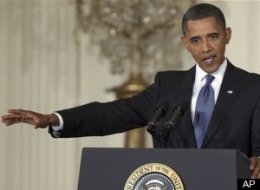
In his first press conference since late May, President Obama offered one of the sternest rebukes to date of the Republican Party's position on the Bush tax cuts, saying that those pushing to extend the cuts for the wealthy are holding the "middle class hostage."

In the process, Obama may have tipped his hand as to how the Democratic Party will structure the forthcoming legislative debate. His position, he said, is to work first on an extension of the tax cuts for those making less than $250,000 a year. After that, Obama added, Republicans and Democrats can debate or vote on whether to continue extending the tax cuts for the wealthy.

"My position is, lets get done what we all agree on," said the president. "What they've said is, 'We all agree that the middle-class tax cuts should be made permanent. Let's work on that, let's do it.' We can have a further conversation about how they want to spend an additional $700 billion dollars to give an average of $100,000 to millionaires. That, I think, is a bad idea. If you were going to spend that money there are a lot of better ways of spending it. But more to the point, these are the same folks who say they are concerned about the deficit -- why would we borrow money on policies that won't help the economy and help people who don't need help."

This seems like one of the clearest indications yet as to how the administration is looking to structure the debate ahead. With a number of moderate Senate Democrats urging the president to extend the full package of Bush tax cuts, there has been growing uncertainty as to whether the president has the votes for extending rates just for those making under $250,000. The compromise proposal most often discussed is to have a temporary extension of all tax cuts, after which Congress can re-consider expiration.

But the White House appears to be homing in on a procedural, not a policy, compromise -- pledge to have two votes: the first on extending the cuts for those making less than $250,000 followed by a second vote on extending the cuts for the wealthy. The former is, as polls show, deeply popular and could get the support of those moderate Democrats provided that a second vote takes place. The latter, owing to opposition among the majority of Democrats in the Senate, may not have the votes for passage.

"I have said that middle-class families need tax relief right now and I'm prepared to work on a bill and sign a bill this month that would ensure that middle class families get tax relief," Obama said at Friday's press conference. "Ninety-seven percent of Americans make less than $250,000 a year... and I'm saying we can give those families, 97 percent, permanent tax relief. And by the way, for those who make more than $250,000, they would still get tax relief on the first $250,000. They just wouldn't get it for income above that. Now that seems like a common sense thing to do. And what I've got is the Republicans holding middle-class tax relief hostage because they are insisting we have got to give tax relief to millionaires and billionaires to the tune of about $100,000 per millionaire, which would cost over the course of ten years $700 billion and the economists say is probably the worst way to stimulate the economy. That doesn't make sense and that is an example of what this election is all about. If you want the same kind of skewed policies that led us into this crisis, then the Republicans are willing to offer that."

Entry #3,141

Those born on September 11th

   The lives of September 11 people usually pivot around certain vital and dramatic decisions which they are forced to make. These decisions may be thrust on them when they are still quite young, perhaps before their sixteenth year. Later, when their career or private life seems to be going smoothly, when they are well established on their path, they will be met with repeated, often unexpected, crossroads. Within a society’s limits on freedom, the power to effect choice may be an individuals greatest right. This fact is not at all lost on September 11 people who know how to wield great power through the choices they make. 

   There is no denying that people born on this day enjoy shocking others. They pride themselves on daring to risk and also enjoy recounting their exploits later. Everything that is boring, middle class, and mundane is rejected by them in thought and deed.   Yet at eh same time they have a tremendous need for the kind of stability that can only be found in a warm, loving family situation.

   Those born on the 11th of the month are ruled by the number 2 (1+1=2), and ruled by the number 2 often make good co workers and partners, rather than leaders.

     Those born on this day are likely to believe in the emancipation not only of women and minority groups, but of all oppressed peoples. They despise any sort of condescending attitude on the part of power holders or politicians toward the masses and resent all false displays of caring or emotions.

Born on This Day:  Lola Falana, Ferdinand Marcos, Tom Landry and Paul “Bear” Bryant

Strengths: Free spirited, nurturing and dramatic

Weaknesses:  Easily bored, manipulative and judgmental

This Day In History:  Sep 11, 2001: Attack on America

At 8:45 a.m. on a clear Tuesday morning, an American Airlines Boeing 767 loaded with 20,000 gallons of jet fuel crashes into the north tower of the World Trade Center in New York City. The impact left a gaping, burning hole near the 80th floor of the 110-story skyscraper, instantly killing hundreds of people and trapping hundreds more in higher floors. As the evacuation of the tower and its twin got underway, television cameras broadcasted live images of what initially appeared to be a freak accident. Then, 18 minutes after the first plane hit, a second Boeing 767--United Airlines Flight 175--appeared out of the sky, turned sharply toward the World Trade Center, and sliced into the south tower at about the 60th floor. The collision caused a massive explosion that showered burning debris over surrounding buildings and the streets below. America was under attack.

Famous Inventions: 1900 A motor vehicle patent was granted to Francis and Freelan Stanley

Entry #3,138

Those born on September 10th

   Those aura surrounds September 10th people is that of capability, and indeed these are focused, resourceful and thoughtful individuals who prefer steering a steady and controlled path through life rather than acting impulsively. Motivated by the urge to bring order and implement progress where before there was chaos and unproductiveness, their attention is drawn to those subjects and situations where they adjudge improvements, thereby hoping that through their efforts they will make a real contribution to the welfare of others.

   Those born on this day are intellectually inquisitive types, they are fascinated by unusual and innovative topics and people, and even if they do not make a career or exploring such subjects as writers, artists or academics, for instance they will still be attracted to boldly individualist characters.

   September 10th individuals have a love of creating orderly structures and strategies with which to bring about direct progress intended to be of wider benefit to others. Blessed with incisive far seeing intellect, practical skills and the gift of patient determination, they have outstanding potential to achieve their goals.

     Those born on this day are ruled by the 1 (1+0=1).   Those ruled by the number 1 generally like to be first in what they do. They communicate with swift mental activity and they have clearly defined views on most subjects. They can be extremely stubborn as well as critical and suspicious.

Born on This Day: Charles Kuralt, Roger Maris, Jose’ Feliciano and Arnold Palmer.

Advice: Pay more attention to yourself not only to your needs but to your wants. Follow your own path and develop the talents you have been given to the fullest. Don’t judge others too harshly, nor yourself. Expand: your horizon to include wider possibilities for the future.

Strengths:  Capable, pragmatic and reliable

Weaknesses: Frustrated, anxious and excitable

This Day in History: Sep 10, 1897: First drunk driving arrest

On this day in 1897, a 25-year-old London taxi driver named George Smith becomes the first person ever arrested for drunk driving after slamming his cab into a building. Smith later pled guilty and was fined 25 shillings.

Famous Inventions:  1891 The song "Ta-Ra-Ra-Boom-Der-E" by Henry J. Sayers was registered.
1977 Hamida Djandoubi, a Tunisian immigrant and a convicted murderer, became the last person executed with the guillotine.

Entry #3,137

Forget What You Know About Good Study Habits

September 6, 2010

Forget What You Know About Good Study Habits

BENEDICT CAREY

NY Times


Every September, millions of parents try a kind of psychological witchcraft, to transform their summer-glazed campers into fall students, their video-bugs into bookworms. Advice is cheap and all too familiar: Clear a quiet work space. Stick to a homework schedule. Set goals. Set boundaries. Do not bribe (except in emergencies).

And check out the classroom. Does Junior’s learning style match the new teacher’s approach? Or the school’s philosophy? Maybe the child isn’t “a good fit” for the school.

Such theories have developed in part because of sketchy education research that doesn’t offer clear guidance. Student traits and teaching styles surely interact; so do personalities and at-home rules. The trouble is, no one can predict how.

Yet there are effective approaches to learning, at least for those who are motivated. In recent years, cognitive scientists have shown that a few simple techniques can reliably improve what matters most: how much a student learns from studying.

The findings can help anyone, from a fourth grader doing long division to a retiree taking on a new language. But they directly contradict much of the common wisdom about good study habits, and they have not caught on.

For instance, instead of sticking to one study location, simply alternating the room where a person studies improves retention. So does studying distinct but related skills or concepts in one sitting, rather than focusing intensely on a single thing.

“We have known these principles for some time, and it’s intriguing that schools don’t pick them up, or that people don’t learn them by trial and error,” said Robert A. Bjork, a psychologist at the University of California, Los Angeles. “Instead, we walk around with all sorts of unexamined beliefs about what works that are mistaken.”

Take the notion that children have specific learning styles, that some are “visual learners” and others are auditory; some are “left-brain” students, others “right-brain.” In a recent review of the relevant research, published in the journal Psychological Science in the Public Interest, a team of psychologists found almost zero support for such ideas. “The contrast between the enormous popularity of the learning-styles approach within education and the lack of credible evidence for its utility is, in our opinion, striking and disturbing,” the researchers concluded.

Ditto for teaching styles, researchers say. Some excellent instructors caper in front of the blackboard like summer-theater Falstaffs; others are reserved to the point of shyness. “We have yet to identify the common threads between teachers who create a constructive learning atmosphere,” said Daniel T. Willingham, a psychologist at the University of Virginia and author of the book “Why Don’t Students Like School?”

But individual learning is another matter, and psychologists have discovered that some of the most hallowed advice on study habits is flat wrong. For instance, many study skills courses insist that students find a specific place, a study room or a quiet corner of the library, to take their work. The research finds just the opposite. In one classic 1978 experiment, psychologists found that college students who studied a list of 40 vocabulary words in two different rooms — one windowless and cluttered, the other modern, with a view on a courtyard — did far better on a test than students who studied the words twice, in the same room. Later studies have confirmed the finding, for a variety of topics.

The brain makes subtle associations between what it is studying and the background sensations it has at the time, the authors say, regardless of whether those perceptions are conscious. It colors the terms of the Versailles Treaty with the wasted fluorescent glow of the dorm study room, say; or the elements of the Marshall Plan with the jade-curtain shade of the willow tree in the backyard. Forcing the brain to make multiple associations with the same material may, in effect, give that information more neural scaffolding.

“What we think is happening here is that, when the outside context is varied, the information is enriched, and this slows down forgetting,” said Dr. Bjork, the senior author of the two-room experiment.

Varying the type of material studied in a single sitting — alternating, for example, among vocabulary, reading and speaking in a new language — seems to leave a deeper impression on the brain than does concentrating on just one skill at a time. Musicians have known this for years, and their practice sessions often include a mix of scales, musical pieces and rhythmic work. Many athletes, too, routinely mix their workouts with strength, speed and skill drills.

The advantages of this approach to studying can be striking, in some topic areas. In a study recently posted online by the journal Applied Cognitive Psychology, Doug Rohrer and Kelli Taylor of the University of South Florida taught a group of fourth graders four equations, each to calculate a different dimension of a prism. Half of the children learned by studying repeated examples of one equation, say, calculating the number of prism faces when given the number of sides at the base, then moving on to the next type of calculation, studying repeated examples of that. The other half studied mixed problem sets, which included examples of all four types of calculations grouped together. Both groups solved sample problems along the way, as they studied.

A day later, the researchers gave all of the students a test on the material, presenting new problems of the same type. The children who had studied mixed sets did twice as well as the others, outscoring them 77 percent to 38 percent. The researchers have found the same in experiments involving adults and younger children.

“When students see a list of problems, all of the same kind, they know the strategy to use before they even read the problem,” said Dr. Rohrer. “That’s like riding a bike with training wheels.” With mixed practice, he added, “each problem is different from the last one, which means kids must learn how to choose the appropriate procedure — just like they had to do on the test.”

These findings extend well beyond math, even to aesthetic intuitive learning. In an experiment published last month in the journal Psychology and Aging, researchers found that college students and adults of retirement age were better able to distinguish the painting styles of 12 unfamiliar artists after viewing mixed collections (assortments, including works from all 12) than after viewing a dozen works from one artist, all together, then moving on to the next painter.

The finding undermines the common assumption that intensive immersion is the best way to really master a particular genre, or type of creative work, said Nate Kornell, a psychologist at Williams College and the lead author of the study. “What seems to be happening in this case is that the brain is picking up deeper patterns when seeing assortments of paintings; it’s picking up what’s similar and what’s different about them,” often subconsciously.

Cognitive scientists do not deny that honest-to-goodness cramming can lead to a better grade on a given exam. But hurriedly jam-packing a brain is akin to speed-packing a cheap suitcase, as most students quickly learn — it holds its new load for a while, then most everything falls out.

“With many students, it’s not like they can’t remember the material” when they move to a more advanced class, said Henry L. Roediger III, a psychologist at Washington University in St. Louis. “It’s like they’ve never seen it before.”

When the neural suitcase is packed carefully and gradually, it holds its contents for far, far longer. An hour of study tonight, an hour on the weekend, another session a week from now: such so-called spacing improves later recall, without requiring students to put in more overall study effort or pay more attention, dozens of studies have found.

No one knows for sure why. It may be that the brain, when it revisits material at a later time, has to relearn some of what it has absorbed before adding new stuff — and that that process is itself self-reinforcing.

“The idea is that forgetting is the friend of learning,” said Dr. Kornell. “When you forget something, it allows you to relearn, and do so effectively, the next time you see it.”

That’s one reason cognitive scientists see testing itself — or practice tests and quizzes — as a powerful tool of learning, rather than merely assessment. The process of retrieving an idea is not like pulling a book from a shelf; it seems to fundamentally alter the way the information is subsequently stored, making it far more accessible in the future.

Dr. Roediger uses the analogy of the Heisenberg uncertainty principle in physics, which holds that the act of measuring a property of a particle (position, for example) reduces the accuracy with which you can know another property (momentum, for example): “Testing not only measures knowledge but changes it,” he says — and, happily, in the direction of more certainty, not less.

In one of his own experiments, Dr. Roediger and Jeffrey Karpicke, also of Washington University, had college students study science passages from a reading comprehension test, in short study periods. When students studied the same material twice, in back-to-back sessions, they did very well on a test given immediately afterward, then began to forget the material.

But if they studied the passage just once and did a practice test in the second session, they did very well on one test two days later, and another given a week later.

“Testing has such bad connotation; people think of standardized testing or teaching to the test,” Dr. Roediger said. “Maybe we need to call it something else, but this is one of the most powerful learning tools we have.”

Of course, one reason the thought of testing tightens people’s stomachs is that tests are so often hard. Paradoxically, it is just this difficulty that makes them such effective study tools, research suggests. The harder it is to remember something, the harder it is to later forget. This effect, which researchers call “desirable difficulty,” is evident in daily life. The name of the actor who played Linc in “The Mod Squad”? Francie’s brother in “A Tree Grows in Brooklyn”? The name of the co-discoverer, with Newton, of calculus?

The more mental sweat it takes to dig it out, the more securely it will be subsequently anchored.

None of which is to suggest that these techniques — alternating study environments, mixing content, spacing study sessions, self-testing or all the above — will turn a grade-A slacker into a grade-A student. Motivation matters. So do impressing friends, making the hockey team and finding the nerve to text the cute student in social studies.

“In lab experiments, you’re able to control for all factors except the one you’re studying,” said Dr. Willingham. “Not true in the classroom, in real life. All of these things are interacting at the same time.”

But at the very least, the cognitive techniques give parents and students, young and old, something many did not have before: a study plan based on evidence, not schoolyard folk wisdom, or empty theorizing.

This article has been revised to reflect the following correction:

Correction: September 8, 2010


An article on Tuesday about the effectiveness of various study habits described incorrectly the Heisenberg uncertainty principle in physics. The principle holds that the act of measuring one property of a particle (position, for example) reduces the accuracy with which you can know another property (momentum, for example) — not that the act of measuring a property of the particle alters that property.


Entry #3,136