RNC targets Harry Reid and Obama on economy with TV ad
Entry #2,650



The time is now 3:12 am
You last visited
June 9, 2026, 10:10 pm
All times shown are
Eastern Time (GMT-5:00)

Obama's new slogan: 'Yes we did!'
Carol E. Lee
July 8, 2010 05:12 PM EDT
KANSAS CITY, Mo. — President Barack Obama has a new campaign slogan.
“Yes, we did.”
And it doesn’t stop there. Republicans, an animated Obama argued Thursday, wouldn’t have.
They wouldn’t have set the economy back on track, he said during a fundraiser for Senate candidate Robin Carnahan, or passed a health care overhaul or financial regulatory reform. Giving the GOP control of Congress again — a possibility that Obama acknowledged — would usher in another era of a “you’re on your own philosophy,” he said.
“You’re going to face a choice in November. This is a choice between the policies that got us into this mess in the first place and the policies that got us out of this mess, and what the other side is counting on is people not having a good memory,” Obama said in a fiery 30-minute speech at the Folly Theater in downtown Kansas City. “They are peddling that same snake oil that they’ve been peddling now for years.”
“Kick ‘em out,” a donor yelled.
“Well, we did kick ‘em out,” Obama replied, “because it wasn’t working.”
With less than four months before voters deliver a verdict on his first two years in office, Obama is adding more muscle to his fight against Republicans and for Democrats. Much of Democrats’ trouble this cycle stems from their votes for unpopular initiatives on Obama’s agenda, including the economic stimulus bill and the health care overhaul. But the president is trying his best to turn that equation around.
“We don’t have to guess how the other party will govern because we’re still living with results from the last time,” Obama said, insisting the GOP’s political approach will fail.
Obama is an imperfect messenger, particularly in a battleground state like Missouri, which he very narrowly lost in 2008 but has visited repeatedly since taking office. His approval rating here is below 50 percent. And earlier this year, Carnahan was seen as distancing herself from Obama by being out of town while he was in her state.
In a sign of the double edge that Obama brings in this election, Carnahan criticized her opponent, Rep. Roy Blunt, for voting for the $700 billion TARP legislation in 2008, calling him “Mr. Bailout” during her introduction of Obama.
Obama voted for the bank bailout bill as a senator.
The president didn’t seem fazed by the ding. Carnahan, the Missouri secretary of state who is running against Blunt for the seat being vacated by retiring Republican Sen. Kit Bond, also promised to “call bull” on Obama if she makes it to Washington.
Obama was at his best. He was in a good mood. He laughed at his own jokes and found the right pitch that connected with the crowd. He was also as partisan as he gets, calling out Republicans by name and having fun at their expense.
“They say no to everything,” Obama said, feigning indignant. “I go and I talk to them, and I say, ‘C’mon we can get something going here.’ No! Don’t want to.”
He again took on House Republican leader John Boehner for comparing Democrats’ financial regulatory reform legislation to killing an ant with a nuclear weapon — “You’ve gotta make a movie: The Ant that Ate the Economy,” he joked. He again knocked Rep. Joe Barton, the Texas Republican who apologized to BP for the administration’s actions during the oil spill in the Gulf of Mexico — “When I heard that, I said, ‘Naw, he didn’t say that,’” Obama said playfully.
The audience laughed. So did he.
“The Bartons and the Boehners and the Blunts. They’ve got that ‘No’ philosophy,” Obama said. “That’s the choice in this election: moving backward or moving forward.”
Voters have seen this movie before, he said, “So we know how this movie ends. Right?"
In a statement, Boehner replied: “On President Obama’s watch, more than 3 million Americans have lost their jobs, and unemployment is near 10 percent. The American people continue to ask, 'where are the jobs?' But the president keeps whining and indulging in childish partisan attacks. How out of touch can he get?”
Obama made the case that despite having no help from Republicans, Democrats have gotten an historic amount of work done in the past 18 months.
In terms of “Yes, we did,” he was putting a fine point on an argument he first made in Toronto when asked about his plans to bring down the deficit. “One of the interesting things that’s happened over the past 18 months as president is, for some reason, people keep on being surprised when I do what I said I was going to do,” Obama said at the time. Vice President Joe Biden repeated the line last weekend in an interview with POLITICO, saying when U.S. troops end their combat mission in Iraq next month, the White House can “point to it and say, ‘We told you what we were going to do, and we did it.’”
On Thursday, Obama said his policies, however unpopular, reflect “what we talked about during the campaign.”
“Folks don’t mean what they say, and they don’t do what they say,” Obama said. “People get surprised when we follow through and keep our campaign promises.”
“Yes we can,” someone yelled.
“Yes we did,” Obama said before jetting off to Las Vegas to headline a trio of events for Senate Majority Leader Harry Reid. “And we’re still doing it.”
LINK TO VIDEO
|
http://www.politico.com/singletitlevideo.html?bcpid=19407224001&bctid=111006782001 |
|
Life without LeBron will pose plenty of challenges for Cleveland Cavaliers
Friday, July 09, 2010, 12:59 AM
John Kuntz
The Plain Dealer
With LeBron James' departure, Mo Williams becomes the most prolific scorer on the Cavaliers, although the team has explored some trade talks with other NBA teams about the veteran guard.
CLEVELAND, Ohio -- LeBron James is no longer a Cavalier, but there will still be 82 NBA games played next season.
Like many of their fans, the Cavs were in a state of shock after James announced he was going to sign with the Miami Heat. As recently as last weekend, the team felt positive that James would re-sign and they could make some adjustments and contend for a championship again next season.
But even though it is a massive blow, losing a two-time Most Valuable Player in his prime, the team did prepare for this contingency. Team owner Dan Gilbert is likely to continue his willingness to spend on payroll and keep the team competitive.
No one will pick the Cavs to contend for the title with Antawn Jamison, Mo Williams, Anderson Varejao and J.J. Hickson. But with some additions, the team does feel it can compete for a sixth consecutive playoff season.
While there is still a chance that the Cavs could do a sign-and-trade with the Heat for James to get back future draft picks, it is unlikely they would take part in helping James go to another team. It is a virtual certainty that the Cavs would not get any players in return, which means they face the reality of losing James for nothing.
The other reality is that the majority of the available top free agents have come to terms with other teams while the Cavs waited on James' decision. Thursday, the first day teams could sign free agents, saw a flurry of activity as the Cavs had to wait on the sidelines.
In addition, without James the Cavs are not going to be an attractive free-agent destination.
The team does have some things going for it. One is that for the first time since 2005, the Cavs will have salary cap space. That is the good news; the bad news is it isn't a large amount.
Note for commenters
We understand your anger, but please show that Cleveland has class: no racism, no vulgarity, and leave his family out of it. Commenters who cross those lines may have their accounts temporarily or permanently suspended.
Without James, for whom the Cavs were saving $16.6 million with their maximum contract offer, they are about $9 million under the salary cap. If they choose to release Delonte West before Aug. 3, they could clear another $4 million.
To get all of that space the team would have to renounce the rights to all their free agents including Shaquille O'Neal, Zydrunas Ilgauskas and Wally Szczerbiak (a carryover from last year).
Using that cap space on free agents, however, may not be the heart of the team's plans. There are several different ways to use space and it can be valuable in acquiring players in trades. That is the route the team is expected to go to improve, part of its after-James plan.
In recent weeks, General Manager Chris Grant has been making calls to check into deals whether James re-signed or not. Most centered around West's contract, which will be valuable in cost-cutting trades. The Cavs have also tested the market for point guard Williams.
After not having first-round picks in three of the last six drafts and no lottery pick since 2004, the Cavs may be looking for trades that bring additional first-round picks. They also may look to sign some of the draft picks they have playing overseas, especially '09 first-round pick Christian Eyenga and '08 second-round pick Sasha Kaun.
Unlike in '03, when the Cavs won James' rights in the draft lottery, there is likely no magic bullet on the horizon. But there are options to improve what James left the Cavs with.
Woman arrested on mistaken charge can't sue
Case is thrown out by appellate court even though she was held in cuffs more than 12 hours
Peter Hermann
The Baltimore Sun 7:59 p.m. EDT
July 8, 2010
Eyrania Smith is, in the words of Maryland's second-highest court, a "truly innocent and injured" person.
Eyrania Smith, in the words of the same judges of Maryland's Court of Special Appeals, has no basis to sue over her mistreatment.
That ruling comes even though all sides agree that Smith was mistakenly arrested on a city warrant that should never have existed, taken away by a police officer who left her two children alone in a car in a highway parking lot, and was shackled by her left wrist and ankles to a pole for more than 12 hours in a Baltimore County police precinct.
Smith had been arrested at 9:08 a.m. on March 26, 2005. She was released from custody at 12:54 a.m. on March 27, 2005. She sued for $2 million in Baltimore County Circuit Court, alleging that her detention amounted to the use of excessive force. A judge threw out the case and on Wednesday the appeals court upheld that ruling.
It appears from reading the court's 25-page opinion that there are so many people to blame for Smith's predicament that no one person or agency can be held responsible for the entirety of her mistreatment.
The judges ruled that the booking officer Smith named in the suit, Michael Bortner, only supervised her detention for a little more than four hours and that he and other officers tried to make her stay more comfortable but were hampered by problems beyond their control.
For example, the three cells in the precinct were filled with men, so there was simply no place to put a woman other than a bench in the hallway outside the fingerprint room. The judicial branch, not the cops, is responsible for determining the legitimacy of a warrant. And officers twice called their city counterparts to pick her up, but they never showed.
The judges unanimously ruled against Smith, even as they conceded: "We believe appellant's situation was very regrettable."
Smith, who lives in Pennsylvania, couldn't be reached for comment, and her two attorneys were not available.
Smith's ordeal began in 2001 when she accepted probation for failing to pay a $215.61 bill to a Rent-A-Center in Baltimore City. She wrote a check the day of her court hearing. But for some reason, authorities couldn't find a record of the payment and requested an arrest warrant. The judge at first issued one, then pulled it back after realizing that Smith had in fact paid. But the recall notice never got into the official record.
And so the warrant lingered until a Baltimore County police officer stopped Smith for speeding on Interstate 83 on March 26, 2005. He took her away, leaving her two daughters, ages 9 and 17, in the car in a Park-and-Ride, even though the teen didn't have a driver's license.
Bortner fingerprinted and photographed Smith, then put her on a bench near a wall, cuffing her left wrist to a pole above her seat and shackling her ankles to a pole running parallel to the wall, according to the court's ruling.
Police then called Baltimore City, where the warrant had originated, and asked someone to come and pick Smith up. At 2:15 p.m., a city officer said the 4 p.m.-to-midnight shift would get Smith. At 5 p.m., a city officer said the midnight shift would handle the call.
At midnight, a county officer finally drove Smith to the city, where they quickly determined that the warrant was an error and released her. She later sued.
But Baltimore County Circuit Judge Judith Ensor ruled that Smith's claim must "shock the judicial conscience," a legal standard for excessive force, and she decided "that Bortner's conduct did not rise to that level."
The Court of Special Appeals ruled that Smith "has not shown a due process violation committed by the single person she has sued." The judges thought the cops made great efforts to get Smith through the process.
"More importantly," they wrote, "numerous actions taken by the county police belie an intention to punish appellant."
LeBron James spurns New York Knicks, the King will join Dywane Wade and Chris Bosh with Miami Heat
Kevin ArmstrongThursday, July 8th 2010, 10:06 PM

Shamus/GettyLeBron James, the former star of the Cleveland Cavaliers, will be joining the Miami Heat.

Keivom/NewsJames arrives at the Boys & Girls Club of Greenwich, Conn.
If LeBron James is to build himself into a billionaire, he will do so elsewhere.
Despite the years of clearing cap space, rearranging their roster to mirror his needs and eventually sending former coach Isiah Thomas as the closer, the New York Knicks' investment of time into James ended Thursday with no return. James, a lifelong Ohio resident from Akron, uprooted from his home state when he announced that he will sign a contract with the Miami Heat. He will join forces with Dwyane Wade and Chris Bosh.
The protracted process lasted eight days and nights. James, who had not spoken publicly since becoming a free agent on July 1, revealed his selection during an hour-long episode on ESPN. He chose to do so at a Boys & Girls Club in Greenwich, Conn.
Guessing James' destination became a parlor game in recent days. At times, media reports mapped James' escape route to Chicago, New York and New Jersey. Others felt that James would not be able to overcome the pull of staying put in Cleveland.
In seven seasons, James has twice won the NBA's MVP award, yet has never won a championship despite reaching the NBA Finals in 2007. The Cavaliers' attempts to revamp their coaching staff with new hire Byron Scott were not enough to placate James, who maintains a mansion in Akron.
New York invested the most hype in its search. For several seasons, Knicks strategized how best to attract James, but as the announcement drew near, it became clear that their efforts had fallen short.
Edmond Pharmacy Burglar Steals Pill Bottles Filled with M&M's
Jul 06, 2010 11:29 AM EDTpdated: Jul 06, 2010 6:45 PM EDT
News9.com
EDMOND, Oklahoma – An Edmond pharmacist got back at a serial burglar by filling the wanted bottles with candy, police said.
According to police, officers responded to an alarm going off at the Clinic Pharmacy, 120 N. Bryant Avenue, at about 5:30 a.m. Sunday. When they arrived, they found the front glass doors of the pharmacy had been broken and four bottles of hydrocodone were missing. The pharmacist informed officers that due to recent burglaries he had filled the bottles with M&M's.
"Hopefully this will be the last time since they realize all they're gonna get is M&M's. They got something. They didn't go away empty handed so it's sort of like sweet revenge on his part," said Glynda Chu, Edmond Police Department spokesperson.
No suspects have been identified.
 Deficit hits $1 trillion in June for second year
The federal deficit in June surpassed the $1 trillion mark for the second straight year, but it's on pace to be slightly lower than last year.
The deficit was $1.005 trillion at the end of June for fiscal year 2010, which is $81 billion less than it was after nine months of fiscal 2009, according to a Congressional Budget Office (CBO) report released late Wednesday.
Tax revenues, due to improved corporate tax receipts, are slightly up while spending is slightly down compared to last year.
If that trend holds, the 2010 deficit would be slightly lower than last year's $1.4 trillion budget shortfall, a record in nominal dollars, and lower than CBO's earlier 2010 deficit projection of $1.5 trillion.
Revenue from corporate income taxes grew 31 percent over the same period in 2009, to $133 billion.
"That increase reflects higher taxable profits in 2010, resulting both from improved economic conditions and from lower depreciation charges," the CBO report said.
The improved revenue from corporations in June could bode well for corporate tax receipts for September, the final month of the fiscal year, CBO said.
The gain from corporate receipts, however, was virtually offset by a 4 percent decline in individual income and payroll taxes. Total tax revenue only improved by 0.5 percent, to $1.597 trillion.
Overall federal spending has dropped this year by about 3 percent, to $2.6 trillion.
That's largely due to about $350 billion less in spending on bailout programs for financial firms in 2010 than last year.
Spending on entitlement programs, the military and unemployment benefits has risen by about 9 percent.
Sam Stein

First Posted: 07- 8-10 10:09 AM | Updated: 07- 8-10 12:54 PM

Over the past few weeks, top Democratic Party strategists have been passed a chart by a concerned, well-respected operative underscoring the daunting task they face in the 2010 elections.
On the left hand side of the chart is a list of ten Republican aligned institutions, ranging from the U.S. Chamber of Commerce to the Family Research Council. Next to it is a column listing the amount of money each group has pledged to spend by Election Day. A third column on the right details what those groups actually spent in 2008 on federal elections.
The number at the bottom delivers the key message. If their pledges are fulfilled, these ten groups will unleash more than $200 million in election-focused spending -- roughly $37 million more than every single independent group spent on the 2008 presidential campaign combined. This time around, almost every single penny will be going to Republican candidates or causes.
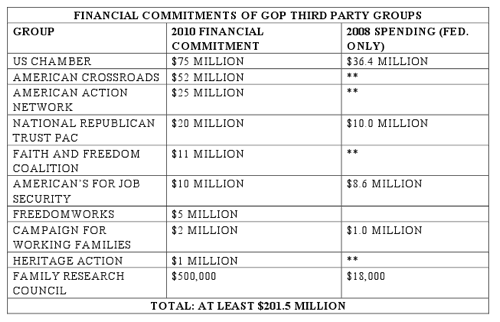
(Update: A Democratic operative makes the case that the total could rise to roughly $300 million if it includes additional pledges for campaign spending from Americans for Prosperity, promising $45 million, the Club for Growth, $24 million, the National Rifle Association, $20 million, and the Susan B. Anthony List, $6 million)
Democrats who received the chart -- which include staff at both congressional committees, the major unions, and many of the most respected campaign hands in the party -- have admitted to greeting it with nervous expletives. It has been passed along to big fundraisers in hopes that they will be compelled to open up their checkbooks.
One top-ranking Democratic operative involved in crafting campaign strategy said he "wouldn't be surprised" if outside groups on the Republican side "outspend us four-to-one." Another top official at a campaign committee called it "one hell of a wake-up call to the left."
"Despite accomplishing much of the check list on the progressive agenda," the official added, "they risk losing it all unless they come together and put their money on the table."
Special interest groups have long tried (with some success) to tip the scales of political election results. But what seems in store for 2010 is historic in nature. The chart was updated late last week after it was reported that the Chamber would make a $75 million commitment to the upcoming elections -- more than twice the amount it had spent in the 2008 cycle (which was then a high-water mark).
The business lobby's expenditures -- done almost exclusively for the benefit of Republican candidates -- would alone have a profound impact on races across the country. But the Chamber is being accompanied by a host of other, ideologically-aligned groups promising to empty similarly deep pockets. American Crossroads, the outlet run by former Bush strategist Karl Rove, has pledged $52 million in expenditures. American Action Network, which is headed by a host of high-ranking GOPers, is promising another $25 million.
"In the context or recent history, it is unprecedented, but speaks to how much is at stake in Washington: power, money and access will be awarded to the winning party," said Craig Shirley, a biographer of Ronald Reagan and Newt Gingrich and a longtime adviser to conservatives. "Everyone in America now has some sort of stake or interest in the affairs of the national government."
Can the money be used effectively? The traditional conduits for cash are the campaign committees which recruit donors through promises of organization, coherent messaging, and effective leadership. But as Shirley notes, activists may end up circumventing the Republican National Committee out of concerns about the competency of its chairman, Michael Steele. The National Republican Senatorial Committee hasn't been treated with similar skepticism by the party's base, but it has only $18 million cash on hand at this point in time.
In interviews with the Huffington Post, several high-ranking Republicans expressed confidence that the outside groups could effectively fill the void the RNC (and, to a lesser extent, the NRSC) was creating. Leadership at these institutions, one operative said, are all veterans of recent high-stakes campaigns, if not well respect tacticians in their own right. Federal law does not, moreover, explicitly prohibit them from coordinating messaging or target lists. They simply can't do so with the campaign committees.
As for the capacity of these groups to actually raise the cash, that too is debatable. It's one thing to promise $52 million in expenditures, as Rove has. It's another thing to deliver. American Crossroads was mocked for raising practically nothing in May 2010, then returned in June claiming $8.5 million in new donations.
Democrats, while predicting that the $200 million objective likely won't be reached, are prepping for an avalanche nonetheless. "It is just one more chess piece on the board," said J.B. Poersch, executive director of the Democratic Senatorial Campaign Committee. "Today, I assume, at least the Chamber's money is real because it was real before. If they say they are going to spend $75 million, I have to assume it is real."
"There's no doubt the Bush boys and big corporate interests -- those who lost the most in the last two years -- are going to try to buy their way back in to power," said Hari Sevugan, press secretary for the DNC. "We are confident that Democrats, as well independents, who don't want that to happen, will put up the resources to ensure that it doesn't."
That confidence is far from universally shared. While it's anticipated that both parties will be able to maintain approximate parity in the amount of money they can spend on congressional races, top strategists are resigned to the likelihood that Democratic interest groups won't match their Republican counterparts. So far this cycle, the activist base -- personified by groups like MoveOn.org -- has been motivated by issue-advocacy and primary challenges, not the Democratic Party's well being.
The major unions are pledging massive resources for the 2010 elections. To this point, they've outspent corporate groups. But their priorities aren't necessarily in line with the campaign committees and the White House. And in interviews with the Huffington Post, top officials held no illusions that they can go cent-for-cent with the Chamber, let alone the nine other Republican-leaning groups.
"Typically, labor unions are outspent by corps around 3 to 1 on elections," said the SEIU's national political director Jon Youngdahl. "We fear that due to Citizens United [the Supreme Court case allowing unlimited spending on campaigns] those numbers are only going to grow. I fear these are the first signs of that growth."
"Will the labor movement be able to match corporate money? No. We never have been and never will," said Karen Ackerman, political director of the AFL-CIO. "But that is not the strength of the labor movement. Our greatest strength is union members and their families."
Faced with a potentially deep financial deficit, grumbling has started to intensify. In private, White House officials are accusing unions of wasting money on fruitless primary challenges; congressional officials are accusing the White House of not doing enough fundraising on their behalf (Obama has done 49 events so far, including two on Thursday, raising over $46 million dollars for candidates and committees); and union officials are blaming congressional Democrats for not passing an agenda that could motivate voters.
It's a far cry from two years ago, when the Obama presidential campaign had a unifying influence on the entire party. The growing concern among strategists is that it could end up producing a self-fulfilling prophesy in which each faction -- convinced about forthcoming midterm losses and skeptical of each other -- can't generate a comprehensive counter-campaign. The one glimmer of hope is that the GOP, even with its deep pockets, could stumble.
"Nature hates a vacuum," said Douglas MacKinnon, a longtime Republican hand and former spokesman for Senator Bob Dole. "And right now the country is taking it out on Democrats to a certain extent. But the country is also looking to Republicans for leadership... and what they are seeing is next to silence because the GOP is just waiting for democrats to self-destruct. Some of the air is coming out of the Republican balloon because they are not stepping into that vacuum or offering solution."
|
|
|
 |
|
|
Steele in 2012? Not so crazy
|
Republican Party chief Michael Steele is either crazy like a fox or a few fries short of a Happy Meal.
His comments since assuming the chairmanship of the Republican National Committee have been weird, his actions crazy and his behavior indefensible. Which leads me to believe he is preparing a run for president.
It is not unthinkable. A demographic plan exists:
The Democratic candidates who win the presidency never win the white vote. Jimmy Carter didn’t, Bill Clinton didn’t (twice) and Barack Obama didn’t. What they do to gain victory is win enough of the white vote and an overwhelming minority vote.
As a black Republican nominee, Steele could get many of the white votes a Republican usually gets while cutting into the Democratic black vote. In this manner, he could defeat Obama in 2012. And that would be his pitch for getting his party’s nomination.
There is a problem with this scenario, however: Is there anyone — black, white, Republican, or Democrat — goofy enough to vote for Michael Steele?
Maybe not. But November 2012 is a long way off. And Steele is staking out his own territory.
Take Steele’s recent comment that Afghanistan is a war “of Obama’s choosing.” There is not a crowded field of people who believe that, considering it was a war of George W. Bush’s choosing, and one designed to keep Al Qaeda from launching further attacks on the United States.
But, according to Steele, Obama failed to understand that “the one thing you don’t do is engage in a land war in Afghanistan.”
Maybe he is right, but because of Bush and Obama, Al Qaeda has been forced to fight for its own survival rather than launching fresh attacks on U.S. soil. (Steele’s follow-up comment issued last Friday — “the stakes are too high for us to accept anything but success in Afghanistan” — hardly cleared things up.)
Some Republican leaders were outraged by Steele, something they have gotten used to since Steele was elected to his two-year term on Jan. 30, 2009, on the sixth ballot. (Some would think that a sixth-ballot victory would call for a quiet consolidation of power. But Steele interpreted it as a call to throw hand grenades. Such is the ambition of future presidents.)
On “This Week” last Sunday, Sen. John McCain (R-Ariz.) told ABC’s Jake Tapper that Steele’s statements were “wildly inaccurate and there is no excuse for them.”
On “Face the Nation With Bob Schieffer,” Sen. Lindsey Graham (R-S.C.) decried Steele’s “uninformed, unnecessary, unwise, untimely comment” before Graham ran out of “uns.”
Dan Senor, a senior fellow at the Council on Foreign Relations and the former spokesman for the Coalition Provisional Authority in Iraq, told Tapper, “What’s striking about Steele is how fundamentally unserious” he is.
Senor is 100 percent correct. But this is the best thing Steele has going for him. Do serious candidates always win the presidency? Did Michael Dukakis? Did Al Gore?
Sure, Obama was serious in 2008, but he sold himself as an agent of change to an unhappy America. In 2012, Obama is going to have to defend the past four years to a (probably) unhappy America.
And how “serious” is politics today when people who believe Obama was born in Kenya, Indonesia or Transylvania are considered a real political movement?
No, serious is not always what you want to be if you want a future in politics.
So when you look at Michael Steele, you are not seeing a man wildly blundering. You are seeing at a man running for president. It just looks like the same thing.
|
|
|
Palin puts out campaign-style video
|
Sarah Palin released a video Thursday that has the feel of an early campaign spot.
The video, titled "Mama Grizzlies," is produced by her political action committee and splices shots of Palin speaking and appearing with supporters and at tea party rallies.
Palin’s remarks in the video, which borrow heavily from her speech to the pro-life Susan B. Anthony List, touts this year as the year of conservative women.
“This year will be remembered as a year when common sense conservative women get things done for our country,” Palin says at the beginning of the nearly two-minute video. “All across this country, women are standing up and speaking out for common sense solutions.”
As Palin speaks, the video shows images of women young and old watching the former Alaska governor and holding signs protesting the Democratic majority in Washington.
One elderly woman in the video is making her way through a tea party rally in a wheelchair with a “Don’t Tread on Me” sign on back.
Another sign reads: “Annoy Liberal: Work Hard & Pay Your Own Bills.”
“These policies coming out of D.C. right now, this fundamental transformation of America — well a lot of women concerned about their kids' futures are saying we don’t like this fundamental transformation and we’re going to do something about it,” Palin says. “It seems like it’s kind of a mom awakening in the last year and a half where women are rising up and saying ‘no, we’ve had enough already.’ Because moms sort of just know when something is wrong.
“We’re going to turn this thing around. We’re going to get our country back on the right track,” she continued. “Look out Washington, cause there’s a whole stampede of elephants crossing the line and the e.t.a. for them stampeding through is November 2, 2010.”
| LINK TO VIDEO | |
http://www.politico.com/singletitlevideo.html?bcpid=19407224001&bctid=110731349001
This puppy’s not property in divorce case
8:11 pm Tue, July 6, 2010
Steve Lash
Daily Record Legal Affairs Writer
Lucky will spend six months a year with each of his owners after a judge refused to order the dog sold.
Call it the Calvert County Canine Custody Case.
As they headed toward divorce, Gayle and Craig Myers had only one bone of contention: Who would have the right to keep Lucky, their 16-pound gray-black Lhasa apso.
Under Maryland law, family pets — unlike, say, children — are treated as jointly owned marital property and sold if the divorcing couple cannot agree on who gets to keep them. The parties then split the proceeds of the sale.
But the standard resolution did not seem right to retired Prince George’s County Circuit Judge Graydon S. McKee III.
The judge, presiding over the limited-divorce proceeding by special assignment, decided on his own last month that Gayle and Craig, who have no children, would split custody of Lucky. The dog will alternate spending six months with each party; Gayle’s turn began on July 1.
McKee rendered his decision after hearing testimony from Gayle, who lives in Alexandria, Va., and Craig, who resides in Dunkirk.
“It was very clear that both of them love this dog equally,” McKee said. “The only fair thing to do was to give each one an equal chance to share in the love of the dog.”
Had either side objected to his unusual resolution, McKee said, he would have applied the law and might have ordered the dog put in the care of a trustee, sold and the proceeds divided.
The judge, 72, said he has owned dogs but that his affection for them did not enter into his decision.
“I really applied good old common sense that my grandmother taught me when I was a little kid,” said McKee, who retired in 2007 as chief judge of the Seventh Judicial Circuit, which includes Calvert County. “Treat other people the way you would want to be treated if you were in that situation.”
McKee’s resolution drew praise from Peter Petersan, litigation director of the Humane Society of the United States. Ordering a sale of the dog “clearly would not have been a just result in this situation” when you have two loving owners, Petersan said. “The judge thought of everyone involved, including the dog, which is fantastic.”
Animal-law attorney Jan Berlage said McKee recognized that dogs and other pets are “family members” and not mere property.
“The judge seems to be taking into account that the common law is changing,” said Berlage, who chairs the Maryland State Bar Association’s Animal Law Section. “Pets have a different role in our lives than farm animals that are fungible and can be replaced.”
Berlage, who said he was speaking for himself and not the section, is with Gohn, Hankey & Stichel LLP in Baltimore.
Attorneys for Gayle hailed what they characterized as McKee’s humane compromise in not requiring the divorcing couple to part with their beloved pet.
“This judge understood the role of pets, and particularly dogs, in the fabric of the American family,” said attorney James S. Maxwell. “The judge appropriately elevated the status of a dog to a member of a family.”
But Maxwell added that only a similar ruling by Maryland’s top court or a change in Maryland law will ensure that McKee’s decision to treat dogs as more than marital property takes root in Maryland.
“Until we have an appellate ruling or legislative change, it’s just one judge’s opinion, one judge’s attempt to do the right thing,” said Maxwell, of Maxwell & Barke LLC in Rockville.
Craig’s attorney, Mark W. Carmean, said McKee’s ruling made for “a rather unique case, and certainly one I’ve never had before.”
Carmean voiced doubt that the judge’s order marks the start of a trend toward pet-custody rulings. “We have a court system that deals with a lot of child-custody cases,” said Carmean, of Lamson, LeBlanc & Carmean LLC in Prince Frederick.
Treating pets in a similar fashion “would take up a lot of judicial time and energy,” he added. “I will leave it to family-law scholars to determine if you can have a visitation schedule for an animal.”
Prior to McKee’s order, Gayle’s lead attorney had offered two alternatives to selling Lucky and splitting the proceeds. The first was a coin toss. Under the second, Gayle and Craig would write on separate sheets of paper the amount they would be willing to pay for Lucky, with the high bid winning custody, said the attorney, Brian M. Barke, Maxwell’s law partner.
“Our client just could not bring herself to have a trustee take her dog and sell her dog,” Barke said.
He added that McKee’s solution was unconventional but correct.
“I don’t think what he did is entirely legal,” Barke said. “He did the right thing.”

Georgia man charged with using Chinese food to smuggle drugs into jail
Matt Elofson
Dothan Eagle
July 7, 2010
Pike County Sheriff’s deputies arrested a Georgia man over the Fourth of July weekend on a charge he tried to smuggle marijuana in to a jail inmate with a container of Chinese food.
Court records show deputies arrested Edward Ridley, 41, of Cordele, Ga., and charged him Saturday with felony promoting prison contraband. Records show Ridley apparently entered the Pike County Jail with a styrofoam container with Chinese food inside, including rice and shrimp, for inmate Vincent Thomas. A jailer at the facility used a fork to search the food and found a bag of marijuana.
If convicted of the class C felony charge, promoting prison contraband, Ridley faces one to 10 years in prison. He was being held in the Pike County Jail on a $7,500 bond.
Metro Atlanta / State News 6:39 p.m. Wednesday, July 7, 2010
Cops: Man holds mom hostage because she won't iron his clothes
The Atlanta Journal-Constitution
A 29-year-old Villa Rica man apparently expected his mother to iron his clothes for him. And when she wouldn't, he pulled a gun and held her hostage for several hours, police said.
Carroll County Sheriff's Office Robert Edward Tyrrell Jr. faces aggravated assault and false imprisonment charges.
Robert Edward Tyrrell Jr. remained in jail Wednesday without bond, Sgt. Marc Griffith with the Carroll County Sheriff's Office told the AJC. Tyrrell faces aggravated assault and false imprisonment following the June 30 incident, Griffith said.
"He wanted her to do some ironing, and when she said ‘no,' they got into an argument," Griffith said. "He told her ‘ironing is woman's work.' "
Tyrrell, who lives with his parents, then pulled out a gun and took his 51-year-old mother's keys and cellphones, Griffith said. The man refused to let the woman leave for at least six hours, investigators said.
“Mama finally said, ‘I’m not ironing your clothes,' and he went cuckoo on her," Griffith said.
The woman was later able to get out of the home and drive to a police station to report the incident, and deputies were dispatched to the home. Eventually, Tyrrell surrendered without incident, Griffith said.
Carroll County Sheriff's Office Robert Edward Tyrrell Jr. faces aggravated assault and false imprisonment charges.
LINK TO PHOTO
Democrats digging harder than ever for dirt on Republicans
Philip Rucker
Washington Post
Staff Writer
Wednesday, July 7, 2010
The Democratic Party is moving faster and more aggressively than in previous election years to dig up unflattering details about Republican challengers. In House races from New Jersey to Ohio to California, Democratic operatives are seizing on evidence of GOP candidates' unpaid income taxes, property tax breaks and ties to financial firms that received taxpayer bailout money.
In recent weeks, the Democratic Congressional Campaign Committee has circulated information to local reporters about Republican candidates in close races. Among the claims:
-- That Jim Renacci of Ohio once owed nearly $1.4 million in unpaid state taxes.
-- That David Harmer of California received $160,000 in bonus and severance pay from a firm that got a federal bailout.
-- That Jon Runyan of New Jersey got a legal break in property taxes for his 25-acre homestead by qualifying for a farmland assessment thanks to his four donkeys.
Renacci's campaign said the candidate did not believe he had tax liabilities for a trust fund and eventually paid all that he owed. A spokesman for Harmer said criticizing him for the money he lawfully earned is a "severe twist of the facts." Runyan's campaign said his actions were legal.
Jon Vogel, executive director of the DCCC, said Democrats are merely pointing out that some Republican recruits in competitive House races are "flawed candidates."
He added, "We have made this election a choice. . . . They're trying to run this national message in part about fiscal discipline, but they've recruited a number of candidates not credible to carry that message."
Opposition research has been a part of political campaigns for decades, but the 2010 cycle is different. In many states, Republicans have steered clear of candidates with long political track records -- eschewing state representatives and veteran city council members who have cast thousands of votes ripe for scrutiny -- in favor of political outsiders. The top GOP recruits include several former professional sports stars, as well as doctors and businessmen.
Democratic leaders are trying to frame the November midterm elections not as a national referendum on the party in power but as local choices between two candidates.
"We can win the contrast, but not the referendum," Democratic strategist Steve Murphy said. "What is critical in this election cycle is for Democratic candidates to hold Republican candidates accountable for their views."
Republicans see the Democrats' strategy as a sign of weakness.
"When the issues are cutting against you, it is typical for a party in trouble to resort to other means," said Ken Spain, spokesman for the National Republican Congressional Committee. "With the unemployment rate unacceptably high and President Obama's approval rating falling, they have nothing left to run on other than character assassination."
Democratic officials are advising campaigns to hire trackers to follow their Republican opponents to public events with video cameras, ready to catch any gaffe or misstatement. And the Democratic National Committee last week issued a call to the public to submit any embarrassing audio or video of Republicans, as well as copies of their direct-mail advertisements.
Party officials would not say how many staffers are working on opposition research. Such work used to be farmed out to campaign consultants, but the DCCC brought research operations in-house in 2008 to be more nimble. "It may appear to be more aggressive this cycle because what we're finding on Republicans is so rich," Vogel said.
In Ohio, Democrats are trying to exploit Renacci's business record in his race against Rep. John Boccieri (D). Renacci, who owns a Chevrolet dealership, nursing homes, real estate investments and sports teams, among other interests, has faced a string of lawsuits related to his businesses.
Democratic operatives circulated a report in April that Renacci owed nearly $1.4 million in unpaid state taxes, interest and penalties. Renacci fought the assessment, believing the money he was holding in a trust was free of state tax liabilities. But after losing a dispute over his liability, Renacci paid everything he owed, said his campaign manager, James Slepian.
"This is a story that the DCCC was pushing pretty hard," Slepian said. "It's unfortunate that John Boccieri has chosen to conduct his campaign by slinging mud from behind Nancy Pelosi's desk rather than talking about the issues that really matter."
But Democrats say the strategy paid dividends in the May special election for the Pennsylvania House seat of the late Democrat John P. Murtha. Republican Tim Burns framed the race as a referendum on Obama and House Speaker Nancy Pelosi (D-Calif.), both unpopular in a district that Obama lost to Sen. John McCain (R-Ariz.) in 2008. But Democrat Mark Critz won handily after tailoring his message to local concerns and attacking Burns for saying he would protect tax breaks for companies that ship jobs overseas.
"Some years you ride the wave, and other years you paddle your canoe," Democratic strategist Paul Begala said. "Democrats, they've got to paddle like hell. So what you do when you're paddling is, as the Republicans seek to nationalize, you localize and personalize."