Obama has no Plan B to drive the Taliban out of Afghanistan
Entry #2,347



The time is now 6:14 pm
You last visited
June 9, 2026, 4:56 pm
All times shown are
Eastern Time (GMT-5:00)

Published: May 21, 2010
Updated: May 22, 2010 10:11 a.m.
Man sentenced for crashing into a tree at a jail
LARRY WELBORN
THE ORANGE COUNTY REGISTER
NEWPORT BEACH – A Los Alamitos man was sentenced to nine years in prison Friday for crashing a car into a tree inside the James Musick Correctional Facility and getting into a fight with a guard.
Matthew Van McDaniel, 25, pleaded guilty to felony aggravated assault on an officer, one felony count of an ex-convict entering grounds of a correctional facility, misdemeanor reckless driving, misdemeanor driving under the influence of alcohol and misdemeanor driving with a blood level of .08 percent or more.

Matthew Van McDaniel
McDaniel was drunk when he drove a Mercedes Benz S550 into the Musick Jail in Irvine at 2 a.m. Jan. 10 and crashed into a tree, according to a news release from the Orange County District Attorney's Office.
When a correctional officer contacted McDaniel, he was punched in the face, prosecutors said. After he was finally restrained, McDaniel showed signs of intoxication, including slurred speech and a distinct odor of alcohol from his breath.
During the booking process, McDaniel tested at a blood alcohol level of .14 percent, according to prosecutors.
The Daytona Beach News-Journal
May 21, 2010 12:05 AM
Southeast Volusia
William F. Biggers

He may have intended it as a joke, but threatening to blow up a woman with a fake hand grenade was no laughing matter, according to Edgewater police.
William F. Biggers, 62, a transient from Oak Hill, was arrested Wednesday morning after an employee at the Dunkin' Donuts on South Ridgewood Avenue told officers he tried to rob her while she was cleaning the store's windows.
Cherish Michelle Williams, 41, said Biggers came up behind her and demanded her money "or he was going to blow up this place." When she turned she saw what she thought was a hand grenade in his hand, police said.
Biggers then told her he was joking and the device was not live.
The responding officer spotted Biggers sitting on a bench a short distance away with the grenade next to him. An investigation showed its explosive components had been removed.
Biggers was taken into custody and charged with aggravated assault before being taken to the Volusia County Branch Jail. He remained there Thursday on $2,000 bail.
Update: ‘The ugly one’ monster mystery
Fri May 21 2010

Mythical creature or water-logged bear cub? A dead animal pulled from a creek in northern Ontario has spawned a range of speculation.
Lesley Ciarula Taylor
Staff Reporter
A snaggle-toothed, furry creature with a bald face and a rat’s tale has mystified natives in northern Ontario, but they have a name and a history for it.
“The elders used to see it a long time ago,” the manager of Sam’s Store in Big Trout Lake told the Star on Friday.
“No one has seen one for 40 years or so. The elders have a word for it: omajinaakoos. In English, it means ‘the ugly one’.”
Two Health Canada nurses training at the Kitchenuhmaykoosib Band reserve south of Hudson’s Bay said their dog Sam hauled out the 30-centimetre creature it found in early May floating face down near the causeway on the reserve, band spokesman Darryl Sainnawap told the Star.
“It looks like a mixed breed of an otter and a beaver,” he said. “We’re just as curious as everyone to find out what it is.”
One band member, 65-year-old John McKay, said he remembered his grandfather talking about such a creature that “feeds on beavers and otters.” Sainnawap’s 80-year-old grandfather had never seen anything like it, though.
Other elders “think it could be a messenger for bad news,” he said. “We’ll see.”
The discoverers threw it back in the water, thinking it was a commonly found northern Ontario beast, Sainnawap said.
The nurses themselves have been posted elsewhere, and staff at the nursing station won’t talk. “We work for the federal government,” said one. “We’re under a gag order.”
Sainnawap rejected speculation that it could be a man-made hybrid created for pictures.
“We don’t play God here.”
Nor would the nurses, he said. “It’s got to have a mother and father out there, so one day we will find out what it is.”
Cryptomundo.com, a site devoted to “elusive and rare animals,” has done an analysis of various small animals’ skulls, with the muskrat seeming a close match—although the nasty teeth were judged un-muskrat-like.
Others speculate it may be the mythical Ogopogo, the Chupacabra or some other marine monster, like the Loch Ness Monster.
“But more realistic considerations have talked about it being a known species, such as a bear cub (Ursus americanus) or other animals. Even the mundane looks strange without hair,” Loren Coleman at Cryptomundo said.
“The other top candidate is that of the North American river otter (Lontra canadensis).”
A New Zealand zoologist examined the teeth, whiskers and paws and decided
“I think this is just another variation of an ordinary creature sculpted by the action of decomposition by water, as I demonstrated last year with the Gisbourne New Zealand Monster that was actually a drowned Opossum.”
LINK TO MORE PHOTOS:
http://www.thestar.com/news/ontario/article/812580--update-the-ugly-one-monster-mystery?bn=1
Bennett compares Tea Party movement to President Carter
Ousted GOP Sen. Bob Bennett fired back at the Tea Party, warning it risked following the path of Jimmy Carter.
In an op-ed to be published Sunday in The Washington Post, Bennet said the Tea Party is repeating the "gloom talk" of President Carter, and will not have a lasting impact on the country unless it changes its tack.
"I urge all of the Tea Partyers to follow Reagan, not Carter," wrote Bennett, who lost his bid for another term in Congress earlier this month after Utah Republican delegates spurned him in favor of candidates backed by the populist conservative movement.
"If they want their movement to be more than a wave that crashes on the beach and then recedes back into the ocean, leaving nothing behind but empty sand, they should stop the 'gloom talk,'" Bennett continued. "These are not the worst times we have ever faced, nor is the Constitution under serious threat."
The comparison of the Tea Party to Carter, an unpopular former president who is ridiculed by the right, is unlikely to go over well with those who identify with the Tea Party.
But Bennett wrote that the tea partiers remind him of those who were fed up with the government in the 1970s after the Nixon presidency and the Watergate scandal.
He said the Tea Party is made up of people who are "fed up with Washington profligacy," just like those who voted for Carter because they were fed up with Nixon.
Bennett also wrote that the Tea Party movement and dissatisfaction with Washington in the grassroots is a more powerful force than most inside the Beltway realize.
The senator said that the Tea Party should avoid being overly negative, like Carter was during his widely-noted "malaise speech" during which Bennett said the Georgian "warned us that America's best days were behind us and suggested that we are a country in irreversible decline. Too many Tea Party speeches sound the same note, even as they invoke Ronald Reagan's name.
Bennett's column is a strong warning to the conservative movement that helped oust him and demonstrates the rift between the Tea Partyers and the GOP political establishment.
Tea Party-backed candidate Rand Paul (R) won the Kentucky Senate primary over Secretary of State Trey Grayson (R) this week, showing the political power of the movement.
But since then, Paul questioned the legality of the Civil Rights Act of 1964 and canceled an appearance on NBC's "Meet the Press" as a result of the fallout. Observers have said Paul's recent problems underscore his political inexperience.
MICHAEL VASQUEZ
Miami Herald
After coming out of the closet this, his senior year at Flanagan High, Omar Bonilla decided to take it a step further: run for prom queen.
He almost won -- Bonilla was among the top three vote-getters -- but in the past few days, it all unraveled.
Fearful that other students would try to beat up a prom-goer in drag, the school administration asked him to wear a tuxedo to Friday night's dance. And after two meetings with the school principal to plead for the right to wear a dress, Bonilla was slapped with a two-day suspension, the timing of which meant he couldn't go to the prom at all.
As students were racing off to prom, Bonilla was putting on his blue sequin dress -- but only to pose for a Miami Herald photographer.
``This week was kind of, like, intense,'' said Bonilla, 19.
It all started last month when the senior at the Pembroke Pines school decided he wanted to run for prom king, but with the intention of wearing a dress. School administrators ran the idea through the higher-ups and told Bonilla that prom queen might be more appropriate -- an option he liked even better.
In soliciting votes from students, Bonilla -- like all other candidates -- posted posters around campus. His read ``vote Omar for prom queen -- time for a change.''
Along the way, Bonilla made the concession that, if he won, the prom king wouldn't have to dance with him, as some kings might not be comfortable doing that.
BEHAVIOR CITEDFlanagan's principal, Sharon Shaulis, referred questions to a Broward schools spokeswoman. That spokeswoman, Nadine Drew, said Flanagan banned Bonilla from prom because of his unruly behavior -- not his unconventional wardrobe plans.
On Thursday, Bonilla had a meeting set up with the school principal -- his second sit-down in two days. He was running late and inappropriately parked in a visitor parking space at the school. When schools police told him to move his car, he didn't heed their warning.
Bonilla said the principal -- citing rumors that other students might try to beat up a prom-goer in drag -- asked for him to come in a tuxedo instead of a dress. A schools police officer sat in on the second meeting.
SAFETY AN ISSUEDrew confirmed that administrators were worried about safety.
``More than ever before, those are real concerns these days,'' she said. ``Those are all taken very, very seriously.''
Bonilla refused to back down. A few hours after he left that second meeting, Bonilla was informed he'd been suspended.
DID NOT WINThat was also the day the school announced Bonilla had come close, but failed to win, the title of prom queen.
``They were looking for an excuse for me not to go, so they said I got suspended for a `minor disturbance,' '' Bonilla said.
The suspension, said Drew, the spokeswoman, was solely because Bonilla had ignored security personnel after parking in the wrong place. Bonilla said he was in a daze that morning and he didn't hear the security guards.
Drew insisted otherwise.
``He did hear them, he turned around, he acknowledged them,'' Drew said. ``But he did not heed or stop. . . He ignored all authority along the way, and that's just not acceptable.''
`UNFORTUNATE'California's Friends of Project 10, a nonprofit which provides educational support services to gay, lesbian, bisexual, and transgender students, called the last-minute nature of Bonilla's suspension ``very unfortunate.'' Education Director Gail Rolf said Bonilla likely could have received help from advocacy groups if there were still time to appeal the decision.
``The question is, would they have suspended another student for the exact same behavior?'' Rolf said. ``Because if not, that's a lawsuit right there.''
Bonilla certainly wasn't the typical prom queen candidate, but openly gay male students have run for the post at other schools before. Last year, at Southern California's Fairfax High, student Sergio Garcia actually won the title of queen, though he nevertheless showed up in a tux.
`PROVE A POINT'Bonilla said Flanagan is generally an accepting place when it comes to gay students, but his desire to wear a dress and become prom queen was aimed at those students who were still scared to reveal their true selves.
``I wanted to just make a stand and prove a point,'' he said. ``Everybody is your friend, and you don't have to care what people say.
``Be fierce about it,'' he said. ``Show that you work it.''
Read more: http://www.miamiherald.com/2010/05/22/1642177/prom-queen-in-a-dress-not-this.html#ixzz0ogVB4gbt
Month After Oil Spill, Why Is BP Still In Charge?
MATTHEW DALY
05/21/10 09:59 PM 
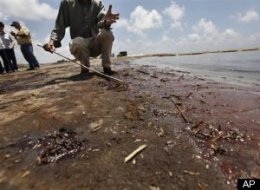
WASHINGTON — Days after the Gulf Coast oil spill, the Obama administration pledged to keep its "boot on the throat" of BP to make sure the company did all it could to cap the gushing leak and clean up the spill.
But a month after the April 20 explosion, anger is growing about why BP PLC is still in charge of the response.
"I'm tired of being nice. I'm tired of working as a team," said Billy Nungesser, president of Plaquemines Parish in Louisiana.
"The government should have stepped in and not just taken BP's word," declared Wayne Stone of Marathon, Fla., an avid diver who worries about the spill's effect on the ecosystem.
That sense of frustration is shared by an increasing number of Gulf Coast residents, elected officials and environmental groups who have called for the government to simply take over.
In fact, the government is overseeing things. But the official responsible for that says he still understands the discontent.
"If anybody is frustrated with this response, I would tell them their symptoms are normal, because I'm frustrated, too," said Coast Guard Commandant Thad Allen.
"Nobody likes to have a feeling that you can't do something about a very big problem," Allen told The Associated Press Friday.
Still, as simple as it may seem for the government to just take over, the law prevents it, Allen said.
Story continues below
After the 1989 Exxon Valdez spill in Alaska, Congress dictated that oil companies be responsible for dealing with major accidents – including paying for all cleanup – with oversight by federal agencies. Spills on land are overseen by the Environmental Protection Agency, offshore spills by the Coast Guard.
"The basic notion is you hold the responsible party accountable, with regime oversight" from the government, Allen said. "BP has not been relieved of that responsibility, nor have they been relieved for penalties or for oversight."
He and Coast Guard Adm. Mary Landry, the federal onsite coordinator, direct virtually everything BP does in response to the spill – and with a few exceptions have received full cooperation, Allen said.
White House press secretary Robert Gibbs was even more emphatic.
"There's nothing that we think can and should be done that isn't being done. Nothing," Gibbs said Friday during a lengthy, often testy exchange with reporters about the response to the oil disaster.
There are no powers of intervention that the federal government has available but has opted not to use, Gibbs said.
Asked if President Barack Obama had confidence in BP, Gibbs said only: "We are continuing to push BP to do everything that they can."
The White House is expected to announce Saturday that former Florida Sen. Bob Graham and ex-EPA Administrator William K. Reilly will lead a presidential commission investigating the oil spill. Graham is a Democrat. Reilly served as EPA administrator under President George H.W. Bush. The commission's inquiry will range from the causes of the spill to the safety of offshore oil drilling.
BP spokesman Neil Chapman said the federal government has been "an integral part of the response" to the oil spill since shortly after the April 20 explosion.
"There are many federal agencies here in the Unified Command, and they've been part of that within days of the incident," said Chapman, who works out of a joint response site in Louisiana, near the site of the explosion of the Deepwater Horizon oil rig.
Criticism of the cleanup response has spread beyond BP. On Friday, the Texas lab contracted to test samples of water contaminated by the spill defended itself against complaints that it has a conflict of interest because it does other work for BP.
TDI-Brooks International Inc., which points to its staffers' experience handling samples from the Exxon Valdez disaster, said the National Oceanic and Atmospheric Administration and the U.S. Fish and Wildlife Service helped audit the lab and approved its methods.
"A typical state laboratory does not have this experience or capacity," TDI president James M. Brooks said.
The company's client list includes federal and state agencies along with dozens of oil companies, among them BP, a connection first reported by The New York Times. TDI-Brooks said about half of the lab's revenue comes from government work.
Test results on Deepwater Horizon samples will figure prominently in lawsuits and other judgments seeking to put a dollar value on the damage caused by the spill.
Deputy Interior Secretary David Hayes, who traveled to the Gulf the day after the explosion and has coordinated Interior's response to the spill, rejected the notion that BP is telling the federal government what to do.
"They are lashed in," Hayes said of BP. "They need approval for everything they do."
If BP is lashed to the government, the tether goes both ways. A large part of what the government knows about the oil spill comes from BP.
The oil company helps staff the command center in Robert, La., which publishes daily reports on efforts to contain, disperse and skim oil.
Some of the information flowing into the command center comes from undersea robots run by BP or ships ultimately being paid by BP. When the center reported Friday that nearly 9 million gallons of an oil-water mixture had been skimmed from the ocean surface, those statistics came from barges and other vessels funded by BP.
Allen, the incident commander, said the main problem for federal responders is the unique nature of the spill – 5,000 feet below the surface with no human access.
"This is really closer to Apollo 13 than Exxon Valdez," he said, referring to a near-disastrous Moon mission 40 years ago.
"Access to this well-site is through technology that is owned in the private sector," Allen said, referring to remotely operated vehicles and sensors owned by BP.
Even so, the company has largely done what officials have asked, Allen said. Most recently, it responded to an EPA directive to find a less toxic chemical dispersant to break up the oil underwater.
In two instances – finding samples from the bottom of the ocean to test dispersants and distributing booms to block the oil – BP did not respond as quickly as officials had hoped, Allen said. In both cases they ultimately complied.
"Personally, whenever I have problem I call (BP CEO) Tony Hayward" on his cell phone, Allen said.
1794 Silver Dollar Sells for Record $7.85 million
May 22, 2010
LOS ANGELES (AP) -- What may be America's oldest silver dollar has become the world's most expensive coin, with its owner saying it changed hands in a private transaction between coin collectors for nearly $8 million.
Steven L. Contursi, who has owned the mint-condition 1794 Liberty dollar for the past seven years, confirmed Thursday that he sold it to the Cardinal Collection Educational Foundation of Sunnyvale for $7.85 million.
The previous record price paid for a coin was $7.59 million for a U.S.-minted 1933 $20 gold piece, according to the American Numismatic Association.
The U.S. began producing silver dollars in 1794, and this particular one remains in near-perfect condition 216 years later.
That being the case, the price it fetched was not surprising, said professional coin grader David Hall.
"Even if it looks like it's been run over by a truck it would still be worth a hundred grand," he said.
Part of the so-called flowing-hair silver dollars, the coin has a portrait of Lady Liberty with long, straight hair on the front and a noticeably skinny American eagle on the back.
"That's the type of piece that is available maybe once in a lifetime," said Martin Logies, curator of the Cardinal Collection, a nonprofit dedicated to preserving rare coins and educating the public about them. He said the foundation plans to put the coin on display, just as Contursi did much of the time he owned it.
Numismatic experts say it was among the first U.S. silver dollars ever made.
"From the research I've done, it is unquestionably the earliest struck of all the pieces known to remain in existence," said Logies, author of "The Flowing Hair Silver Dollars of 1794."
Of the approximately 1,750 such dollars produced that year, only about 150 are known to exist.
The quality of the imprint on this one shows it was struck on a hand-cranked press from a special piece of polished, high-quality silver. That indicates it was intended for either a dignitary or the mint's own private collection, said Larry Shepherd, executive director of the American Numismatic Association.
It likely remained in the mint's collection until the 1800s, Shepherd said, when it was probably traded to a private collector, something he said the mint sometimes did in those days.
Contursi, who runs Irvine-based Rare Coin Wholesalers, acquired it for an undisclosed sum in 2003. He said he wasn't looking to sell it until Logies approached him.
The Cardinal Collection curator had been one of a handful of experts Contursi had allowed to examine the coin after he bought it. He joked that Logies had had his eye on it ever since.

Teenage driver prefers jail to writing sentence 2,500 times
The Atlanta Journal-Constitution
A 19-year-old Clayton County woman says she would rather go to jail than write 2,500 times “I will not dishonor myself by passing a school bus,” her punishment for a March traffic offense.
Nancy Nguyen told WSB-TV it would be a lie to write that sentence because she didn’t intentionally pass the stopped bus; two tractor-trailer trucks blocked her view, she said.
So she doesn’t feel she is dishonored.
"I'm not going to demean myself and be demeaned by other people," Nguyen told WSB.
According to the news account, Forest Park’s solicitor said it is common to require drivers younger than 21 to write those sentences if they passed a stopped school bus. The idea is to impress upon them that it is a serious and dangerous traffic offense, the solicitor told WSB.
"Writing something that many times ... it wouldn't teach me anything," Nguyen said.
A school crossing guard told WSB passing a stopped school bus can be deadly. "Kids will run, they [are] always running. So if you see the stop sign just stop," Pat Harris said.
By May 26, Nguyen is to have the sentences written and have completed 24 hours' community service and a defensive driving course. She also must have paid a $350 f ine by then, her next court date.
Her license will be suspended for six months.
Nguyen could be sent to jail if she has not completed all her sentence.
LINK TO VIDEO:
http://www.wsbtv.com/news/23625350/detail.html
http://www.ajc.com/news/clayton/teenage-driver-prefers-jail-532368.html
Thursday, 05.20.10
NORTH MIAMI-DADE
Who's behind I-95 billboard featuring George Bush?
A billboard featuring former President George W. Bush has popped up along Interstate 95. In this election year, who's behind it? It's a mystery.

STEPHANIE GENUARDI
Miami Herald
The billboard with a singular image along southbound Interstate 95 towers high above all others.
It features a smiling face of former President George Bush asking drivers a simple question:
``Miss Me Yet?''
No one knows whether this is part of a nationwide movement, but similar billboards have popped up in other spots around the country, some offering witty responses.
Locally, the indigo blue billboard between 151st and 135th streets in North Miami-Dade is getting its own set of smirks.
``It sounds hilarious,'' said Aida Zayas, of the Republican Party of Miami-Dade County, who said she had not yet spotted it. ``I look forward to seeing it.''
Other drivers clearly have, and are more than happy to share their thoughts. A phone number is listed on the billboard, which leads callers to a voice mail message: ``Please leave any comments about the billboard after the tone.'' Wednesday, the voice mail box was full.
The person behind the billboard remains a mystery. The name attached to the phone number belongs to Robert Nuñez. There are several people with that name in Miami-Dade County.
New York-based CBS Outdoor owns the 14-by-48-foot billboard, which costs between $3,000 and $5,000 a month to rent, said spokeswoman Jodi Senese. She refused to give up any information about who rented it.
This is not the first billboard to feature the beaming mug of the former president and the ``Miss Me Yet?'' message.
In December, a billboard expressing the same message beneath a waving George Bush popped up along Interstate 35 in the town of Wyoming, Minn., about 15 miles north of Minneapolis-St. Paul.
``It caused quite a stir,'' said Mary Teske, general manager of Schubert and Hoey Outdoor Advertising, the company that leased the Minnesota billboard.
After the media caught wind of the billboard in early February, Teske said she was ``bombarded with calls.''
After ``constant media contact,'' Teske eventually informed the public that ``a group of small-business owners'' who wished to remain anonymous had rented the billboard.
The Minnesota billboard may have been the first of its kind to appear in the country. Teske said she has heard of others in different states.
An Internet search shows media reports about billboards outside Dallas and in Clearwater, Fla., near St. Petersburg.
The Minnesota billboard, still up five months later, continues to garner attention. Sometimes, Teske picks up the phone only to hear hysterical laughter.
``It started a wave of people wanting to do their own,'' she said.
Teske said whether folks agree with the message or not, ``It's neat to see freedom of speech alive and well.''

