7 Holy Body Parts From Around the World
Entry #2,075



The time is now 11:04 am
You last visited
June 8, 2026, 7:45 pm
All times shown are
Eastern Time (GMT-5:00)

From Outrage To Yawns: How War Has Dropped Off The Political Landscape
First Posted: 04- 8-10 06:05 PM | Updated: 04- 8-10 07:35 PM
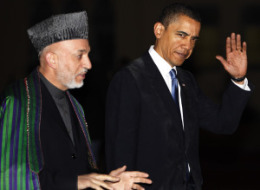
 Over the past few weeks, a slew of dispiriting news has accompanied U.S. efforts in both Afghanistan and Iraq. Abstruse and bizarre comments from Afghan President Hamid Karzai has troubled America's diplomatic community; violence has followed the election of Iraqi president Iyad Allawi; and a leaked, two-year old video showing the killing of civilians in New Baghdad has raised fundamental questions about U.S. military policy.
It's the type of story sequence that two years ago would have produced howls in Congress and, perhaps, forms of demonstration outside the Beltway. Today, they've had a negligible fallout.
America's military campaign in Afghanistan and its drawdown in Iraq are hardly resonating on the political landscape. Lawmakers who came to office in recent years largely on an anti-war wave aren't touching the topic. Progressive groups -- who rallied feverishly against the Iraq War and opposed to further escalation in Afghanistan -- have ceded that debate is now static. Even those in charge of getting Democrats elected to Congress argue that there will be little friction within the party over the course the wars are taking.
"I think that people will understand what the stakes are going into November even if there may be disagreement with the president, whether it is on Afghanistan or some other foreign policy," said Rep. Chris Van Hollen (D-Mary.) who chairs the Democratic Congressional Campaign Committee. "[T]here are clearly going to be Democrats who disagree with president's polices on Afghanistan. I still believe that they will be moved and motivated to come out to the polls for all the other issues that are at stake."
It's a remarkable reversal from where the state of play stood just a few years ago. Back in October 2007, 62 percent of respondents in a Gallup survey labeled the Iraq war as their top priority (more than double the next issue: health care). This past March, only five percent of respondents in a Bloomberg poll said that the war in Afghanistan was the most important issue facing the nation right now, trailing, among other items, spending and the deficit.
Not all polling numbers echo Bloomberg's. And the differences between Iraq in 2007 and Afghanistan in 2009-2010 are vast. But the fundamental message sent by the digits is shared among foreign policy and public opinion experts: war abroad is spurring yawns at home.
"It is out of the minds of voters because it is not on the news," said Mark Blumenthal, editor and publisher of Pollster.com. "It is not on the news they watch on television or the news they read in the papers or online. Couple that with the fact that the economy is a big deal and people are paying much less attention." 
How this development took place is owed to a confluence of contemporaneous events. As Blumenthal notes, a lagging recession has consumed the attention of much of the American public. A health care battle that lasted longer than a year has sucked the oxygen out of Congress. Finally, the country is suffering from a collective bit of war fatigue having watched the operation in Afghanistan progress for more than nine years; and that in Iraq, seven-plus.
And yet, the fact that Karzai's threats to join the Taliban haven't resonated further on the political stage -- or that a leaked 2007 video showing U.S. military personnel shooting a group of journalists and onlookers in Baghdad hasn't triggered larger howls of outrage -- can't, for some, be explained by these factors alone.
As it stands now, the groups that would traditionally express the loudest concern with such developments are choosing, instead, to stay largely muted. John Isaacs, the Executive Director of the Center for Arms Control and Non-Proliferation, said his organization remains frustrated with the situation in Afghanistan. But rather than work actively against the Obama administration in an effort to get troops out, they have instead invested their energies towards policy they actually think they can affect: nuclear weapons proliferation.
"We have a possibility of achieving positive things as opposed to working against negative events. We are trying to work for nuclear treaties and get weapons removed," Isaacs said. "It is more satisfying to get a positive accomplishment then to work against something we don't like."
Having a Democratic president in office has, indeed, changed the dynamics in fundamental and sometimes difficult ways for the progressive community. And it's not just simply because it presents more opportunity for collaboration than existed under George W. Bush. While a variety of organizations and lawmakers have come out against the surge of troops in Afghanistan, it's not clear if the message has disseminated to their constituencies or memberships. It certainly hasn't been picked up by the broader public. Stan Greenberg, a prominent pollster within the party, noted that Obama enjoys his highest approval ratings on Iraq and Afghanistan. Some of the messaging he's tested, meanwhile show that "voters are very responsive where Democrats talked boldly about our foreign policy of taking it to the terrorists."
For a group like MoveOn.org this presents a bit of a depressing dilemma. The organization, which cut its teeth opposing the war in Iraq, came out publicly against Obama's plans to send more troops to Afghanistan in early December. Since then, little has been done to push their members on this front. While MoveOn's electoral roundups from 2006 and 2008 both tout the fact that they siphoned a strong anti-war sentiment into an electoral force, currently the group doesn't list Afghanistan on its website's home page.
"Our members still have a watchful eye on the events unfolding in Afghanistan and Iraq, but the combination of trust in President Obama's promise of diplomacy and withdrawal and an economy that means they are struggling to make ends meet at home has kept the wars from being a flash point for sustained political activism this past year," said Ilyse Hogue, the organization's communications director.
If having a Democratic president in power has created a kind of political paralysis for Democratic voters opposed to the Afghan surge, the situation on the ground has created legislative lethargy for lawmakers. House liberals, led by Rep. Dennis Kucinich (D-Ohio), were able to force a vote this past month to cut off the funding for continued operations. It failed. Sen. Russ Feingold (D-Wis.), meanwhile, is set to introduce legislation calling for a "flexible timetable" for a troop withdrawal. Beyond that and the occasional hearing the cupboard has been bare. And the main reason why, experts say, is because the options (at least right now) are limited.
"There isn't another leader we can turn to. I think that was apparent from the election," said Teresita Schaffer, director of the South Asia Program at the Center for Strategic International Studies. "I suppose in principle the U.S has the option of providing less support to Karzai but at the moment that would be a perverse option because a strategy that includes increasing military strength rests on three legs: economic, military and political. And the latter two rest on having a government in place that can exercise leadership."
Of course, Feingold, Kucinich, and a whole host of other voices would disagree with such a premise. Why America has invested so much in Karzai -- or for that matter Afghanistan -- in the first place remains a mystery. Any further involvement, likewise, is money, time and lives wasted. But the voice that matters, in the end, is Obama's. And to this point he has neither been pushed, nor shown much willingness, to alter his plans.
"I think it is true that progressives do not want to take on this war partly because they think it will hurt their specific domestic causes, partly because they think it will be disloyal to Obama," said Robert Greenwald, the activist filmmaker who has spearheaded anti-war efforts. "In the end, not pushing Obama on this is one will be one of the greatest single mistakes progressive will make and will continue to make."
Oil drilling prompts Al Gore's first public split with President Obama
President Barack Obama’s decision to allow expanded offshore oil drilling prompted the first public criticism of his administration from Al Gore’s environmental advocacy group, the Alliance for Climate Protection.
The organization, which the former vice president founded and chairs, put out a statement last week opposing the new policy.
The statement is significant because it marks Gore’s first break with Obama on his signature policy issue, nearly two years after Gore’s enthusiastic endorsement gave the Illinois senator a jolt of momentum following the divisive Democratic presidential primary.
Gore and the Alliance have appeared to avoid direct criticism of the president in the past when they’ve had disagreements, and have often cheered on the administration.
When Obama announced a plan to back construction of new nuclear power plants, another move denounced by environmental groups, Gore’s group remained silent.
On the oil drilling announcement, however, the Alliance made its opposition clear.
“This plan continues our reliance on dirty fossil fuels — we cannot simply drill our way to energy security,” the Alliance’s CEO, Maggie Fox, said in the statement. “What we need now is presidential leadership that drives comprehensive clean energy and climate legislation that caps harmful carbon pollution, puts America back to work, ends our reliance on foreign oil and keeps us safe.”
Asked if the Alliance statement represented the former vice president’s views, Gore spokeswoman Kalee Kreider replied: “Former Vice President Gore did not release a statement, but the philanthropy he chairs did.”
But Gore made his own views explicit on Wednesday when he sent a Twitter message hailing a “great post” from Fox on a blog reiterating her earlier statement.
Obama’s announcement last week was seen as an olive branch to the oil industry and to fence-sitting senators whose votes are needed to pass sweeping climate and energy legislation that includes a cap on carbon emissions.
While other environmental groups have not been shy about criticizing compromises that they view as overly generous to industry interests, Gore and the Alliance have played the role of cheerleaders for Obama’s yearlong push for a comprehensive bill. Their public statements have promoted positive developments in the process and lauded Obama’s use of the presidential bully pulpit.
Where Gore has voiced frustration with the slow pace of U.S. action on climate change, he has directed his ire at the Senate, where a House-passed energy bill has languished for more than nine months. The Nobel laureate was disappointed with the outcome of the Copenhagen global climate talks last year, but in a New York Times op-ed in February, he said the failure came “in spite of President Obama’s efforts.” Instead, he blamed Senate inaction, saying it had “guaranteed that the outcome would fall far short of even the minimum needed to build momentum toward a meaningful solution.”
RELATED ARTICLES
The oil drilling announcement has divided some environmental advocates. While there is widespread opposition to the move on policy grounds, some have said it’s an acceptable compromise if it helps to win support for the broader climate and energy bill.
The head of Clean Air Watch, Frank O’Donnell, said the Alliance has “by and large tried to promote an upbeat and positive message” about the climate legislation. “It’s not in their interest to slam Obama,” he said.
But the drilling expansion may have been a bridge too far, O’Donnell said. The policy, he said, “has absolutely nothing to do with climate.”
“It’s vote-buying, pure and simple,” he said.
Other advocates were more surprised by the Alliance statement.
“They could have been looking for a way to demonstrate their independence,” said Green Strategies President Roger Ballentine, who headed the White House Climate Change Task Force during the Clinton administration. He cautioned that he was speculating and did not know the reason for the Alliance’s criticism.
Ballentine said he thought Gore would continue to play “an enormously constructive role” in the congressional debate. “I fully expect the former vice president to be supportive of a reasonable compromise,” he said.
Ex-Giants superstar Tiki Barber has dumped his 8-months-pregnant wife, Ginny, for sexy former NBC intern Traci Lynn Johnson, sources told The Post last night.
The football star-turned-"Today" show-correspondent left his wife of 11 years, Ginny, for the 23-year-old blonde, who also worked at 30 Rock, the sources said.
Ginny, who is expecting twins, found out about the relationship late last year, after the run-around running back moved out of their Upper East Side home.
Johnson, a model-thin bombshell, was photographed sitting next to Tiki last month at a Washington, DC, screening of a documentary on Senegal that he hosted for the Travel Channel. Sources believe Johnson also accompanied Tiki to Senegal for the filming late last year, when Ginny was three months pregnant.

Traci Johnson wears the jersey of her Giant stud

NY Post: Charles Wenzelberg
Tiki Barber -- here with the wife he's walking out on, Ginny.
The affair is particularly stunning in light of Barber's long-standing disdain for his philandering father.
"I don't give a [bleep] that the relationship didn't work," he said of his parents' split in a 2004 Post interview. "Not only did he abandon her, I felt like he abandoned us for a lot of our lives. I have a hard time forgiving that."
Barber's confidants were shocked.
"He was always the nice guy with a million-dollar smile," a Barber family friend told The Post.
"We were shocked to find out that he could walk out on his wife of 11 years while she's pregnant with twins. He was with this girl in Senegal while Ginny was three months pregnant.
"And we believe she was also with him in Vancouver while he was blogging about the Winter Olympics for Yahoo.com."
Barber, who is believed to have to have relocated to an Upper West Side bachelor paid, released a statement yesterday in response to a Page Six item announcing the split.
"After 11 years of marriage, Ginny and I have decided to separate," Barber said. "This decision was a painful one, but we are moving forward amicably and will continue to work together to raise our children with the love and dedication they have always known."
A Tiki Barber spokesman declined to comment.
Ginny is a former fashion publicist and full-time mom to the couple's two sons, A.J., 7, and Chason, 6. She, too, declined to comment.
But she's been known to tout her caretaking role for Tiki.
"I'm sort of a traditionalist where I don't mind taking care of him," she said in a 2006 interview.
Johnson can be seen posing with a smiling gal pal in a pic on her MySpace page. The two are wearing red short shorts and Giants jerseys emblazoned with Barber's No. 21.
Tiki and Ginny began dating 16 years ago when both were students at the University of Virginia.
Barber, who turns 35 today, was hired by NBC just after he retired in 2007 -- when sources say he first met Johnson, who was working there as an intern.
In his 10-year NFL career, Barber set nearly every career offensive record for the Giants, and made three Pro Bowls.
His end run on Ginny with the much younger Johnson runs counter to the all-American Barber persona that fans and TV viewers know.
During Giants games, Tiki used to blow a kiss to Ginny in the stands every time he scored.
In his 2007 memoir, "Tiki: My Life in the Game and Beyond," Barber described the example he wanted to set for his kids.
"I want to be an honorable man, because that's what I want them both to be," he wrote, noting, "My family is everything to me."
Read more: http://www.nypost.com/p/news/local/timing_tiki_plays_field_TMZxMDNXxvBbNgVBToZL8O#ixzz0kVp437hM
 MORRIS: GOP will win House, Senate
Stanley Greenberg and James Carville claim that the Republican Party has peaked too soon.
Stanley Greenberg and James Carville claim that the Republican Party has peaked too soon. Incredibly, Greenberg says that “when we look back on this, we’re going to say Massachusetts is when 1994 happened.” Stan’s only claim to expertise in the 1994 elections, of course, is that he’s the guy who blew it for the Democrats. Right after that, President Clinton fired both of the flawed consultants and never brought them back again.
Their latest pitch is that the highpoint of the GOP advance was the Scott Brown election and that, from here on, things will “improve slightly” for the Democrats.
Once again, Carville and Greenberg are totally misreading the public mood. Each time the Republican activists battle, they become stronger. Their cyber and grass roots grow deeper. The negatives that attach to so-called “moderate” Democratic incumbents increase. And each time Obama, Reid and Pelosi defy public opinion and use their majorities to ram through unpopular legislation, frustration and anger rise.
Were Obama’s ambitions to slacken, perhaps a cooling-off might eventuate. But soon the socialist financial takeover bill will come on the agenda, followed by amnesty for illegal immigrants, cap-and-trade and card-check unionization. Each bill will trigger its own mobilization of public opposition and add to the swelling coalition of opposition to Obama and his radical agenda.
And, all the while, the deficit will increase, interest rates will rise and unemployment will remain high.
Meanwhile, the political process will generate more and more strong Republican challengers. We have yet to see if former Gov. Tommy Thompson of Wisconsin or Dino Rossi of Washington state will emerge to challenge Sens. Russ Feingold (D-Wis.) and Patty Murray (D-Wash.). Better House candidates will decide to capitalize on the momentum and will jump into the race and Republican donors will come out of hiding, their efforts catalyzed by the growing optimism about GOP chances.
Presaging the looming Republican sweep is the shift in the party ratings on various issues. Rasmussen has the Republicans ahead by 49-37 on the economy and 53-37 on healthcare. His likely-voter poll shows GOP leads on every major issue area: national security (49-37), Iraq (47-39), education (43-30), immigration (47-34), Social Security (48-36) and taxes (52-34).
When Republicans are winning issues like education, healthcare and Social Security — normally solidly Democratic issues — a sweep of unimaginable proportions is in the offing.
Will the rise in economic growth and job creation — if they continue — offset the Republican gains? Not very likely. Remember Bill Clinton’s 1994 experience. Even though the recession had officially ended in the quarter before he took office and he proudly pointed to the 5 million new jobs that had been created during the first two years of his presidency, Clinton got no bounce from the jobs issue or the economy. Even in the election of 1996, the economy was only marginally a source of strength for the Democratic president. It wasn’t until impeachment that the job growth that had been ongoing since he took office began to work heavily in his favor with the public. The hangover from a recession, and certainly from one as violent as this, lasts a long time. A very long time.
And all this assumes that things will, indeed, improve. Worries about inflation loom large and concerns that higher taxes and interest rates will trigger a new downturn also abound. As long as the deficit is as high as it is, there is no solid foundation for a sustained period of economic growth.
Finally, Obama is now responsible for healthcare in America. When premiums rise, it will be his fault. When coverage is denied, it will be on his watch.
When Medicare cuts kick in, it will be Obama who gets the blame.
Carville’s last book touted “40 more years of Democrats.” Now he dreams of a loss of “only” 25 seats in the House and “six or seven” senators. But these are pipe dreams. Republicans will gain more than 50 House seats and at least 10 in the Senate, enough to take control in both chambers. That’s reality.
Murdoch: Palin not on Fox as journalist
Sarah Palin’s role on Fox News is as a commentator, not a journalist, according to media mogul and Fox News owner Rupert Murdoch.
Murdoch also said ratings leap whenever the former Alaska governor is on, and “we’re not adverse to high ratings.”
“I do believe the public wants good, ethical journalism — but they also want to be entertained,” Murdoch said.
The Fox News chief made the comments at the National Press Club on Tuesday night for a taping of the "Kalb Report."
Murdoch said that he is not a Republican nor a conservative, but “maybe a radical.”
He also said he believes in change, and that “sometimes strong change can be good.”
Murdoch also took on suggestions that Fox is a biased news source.
“There’s no conscious angling of the news,” Murdoch said.
Asked to name a Democrat on his news network, Murdoch paused for a bit before naming Greta Van Susteren.
“Greta Van Susteren is certainly close to the Democratic Party,” he said.
And when it comes to Fox’s rival networks, Fox sets the centrist example, according to Murdoch. Rival networks “tend to be Democrats. Let’s be honest about it,” Murdoch said.
Murdoch claims The New York Times “clearly has an agenda.” When asked to clarify that agenda, Murdoch replied, “Anything Mr. Obama wants.”
Murdoch maintains, however, that if Obama were to go through with the education reforms he has talked about so often, Murdoch would definitely support him.
Firefighter arrested on suspicion of pulling fire alarm at Port St. Lucie lounge
Will Greenlee
April 6, 2010 at 10:11 a.m. , updated April 6, 2010 at 1:08 p.m.

PORT ST. LUCIE — A firefighter in Riviera Beach was arrested after activating the fire alarm at a lounge while drunk in February at a supervisor’s birthday celebration, according to recently-released records.
Charles Robert Sunser, 31, was arrested Saturday on a misdemeanor making false report charge following the early February incident at The Element lounge in the 2000 block of Northwest Courtyard Circle, records show.
“I did something stupid, I’m very drunk and didn’t mean to cause trouble,” Sunser is quoted as saying in a Port St. Lucie police report. “We are here for my boss’s birthday, I’m sorry.”
Sunser, of Palm Beach Gardens, told police he works in Riviera Beach for “their” fire department. He said he and some co-workers came to the lounge for a supervisor’s birthday celebration. He said he “got really drunk and made a mistake.”
A phone message left Tuesday morning with the Riviera Beach Fire Department wasn’t immediately returned.
Two Element employees saw Sunser activate the fire alarm at the front door, according to the report.
A man identified as Element’s owner told police he wished to pursue charges, noting the “malicious nature” of the incident and the lost revenue caused by the “disruption and evacuation.”
http://www.tcpalm.com/news/2010/apr/06/firefighter-arrested-after-allegedly-pulling-at/
Jobless Numbers Show Minorities Crushed by Team Obama Policies
Lurita Doan
The Obama Administration is putting the best face on the Bureau of Labor Statistics’ (BLS) recent March 2010 jobless numbers report, touting the steady nationwide jobless number of 9.7%. But for minorities, the news is bad and getting worse.
The really bad news is buried in the middle of the 38 page report. The BLS data reveals an alarming and growing divergence between the number of white and the number of minorities that are unemployed. Worse yet, it is clear that minorities, especially African Americans, are falling further behind. If unchecked, the long term implications of that imbalance are nightmarish for the nation.
Larry Summers and others in the Administration have not yet shown much interest in the appalling unemployment rates for minorities and, instead, exude childlike enthusiasm at the nation’s overall jobless rate that held steady for the 2nd consecutive month.
While the unemployment for white Americans averaged 9.3%, African Americans averaged 16.6%, just a little less than double the rate of white unemployment. Hispanic Americans reported 13.3% unemployment, while recent, young veterans are averaging 14.7%. Black men, over 20 years old, are showing 20.2% unemployment and teenaged, African Americans, ages 16-19, of both sexes, show a mind-boggling 39.3% unemployed. Hispanic teens also report a staggering 30.3% unemployment. The long-term repercussions of these unemployment numbers are troubling, yet the Administration is curiously silent.
Team Obama has spent trillions of dollars and enormous political capital advancing stimulus plans and other empty calorie policies that have failed to spark employment, especially among minorities. Instead, Obama’s policies have only further eroded American competitiveness, hindered job creation. African Americans, Hispanics and other minorities, are finding themselves out of work, for longer and longer periods of time.
Soon, Congress and the President are going to have to face the growing realization that unemployment rates have been so elevated for so long among minorities that minorities in the U.S. are now on the precipice of permanent unemployment.
We need to start asking ourselves: when do the temporary wards of the state, the unemployed, become permanent wards? Is the presence in the United States of a permanent, non-working class, comprised predominantly of minorities, the change that Obama promised? What does this shift mean to us as a nation, where there is a strong likelihood that a growing majority of white citizens will be working and a growing majority of minority citizens, such as African Americans, will not?
It seems rather clear that without a job, and with little hope of finding one, the end result is that those minorities may become increasingly dependent on government entitlements.
What is especially troubling about Team Obama, is that they do not yet seem to be thinking about solutions to these problems. Instead, they exhibit a keen desire to maintain the fantasy that recovery is just around the corner, and the nation will soon return to a period of full employment. But, most likely, those days are gone.
What Congress and Obama have yet to fully grasp is that they have expanded the social safety net and further extended entitlements but at a cost of diminished entrepreneurial energies, less job creation, and potentially, permanently higher unemployment rates.
Young men and women with no job, and little hope of finding a job, represent a strain on the social fabric of the nation as they become angry and resentful over the lack of employment opportunities. They will need, and demand, additional aid and support from the government, so social spending is likely to only grow.
These new social costs will require even higher taxes to pay for all of the new programs, so our nation can probably expect rising social tensions from the mostly white Americans that will be asked to pay higher taxes to support the many new forms of government spending and more expansive entitlements and social spending.
The consequences of a growing and prolonged unemployment within the minority community, combined with preferential legislation, create a dangerous racial <snip>tail of time, idleness and increased expectation of entitlements. As a result, the things that divide us as a nation will likely grow.
How sad that a likely result of Obama administration policies may be that the steady improvement of race issues over the past 60 years could come to an end.
There is a growing likelihood that, with significantly more white Americans having jobs and paying taxes than African Americans or Hispanic Americans, anger over bearing an unduly heavy tax burden may be perceived as racism when it’s nothing of the sort.
Racial tensions may grow and resentments may fester, as a large group of young minorities become permanently underemployed. George W. Bush, several years ago, kicked off a heated debate with his notion of the “soft bigotry of low expectations.” Who could have foreseen that the unintended consequences of President Obama’s “audacity of change” would be a different sort of bigotry that could increase national racial tensions based upon no expectations and a permanent dependency upon the federal government?
Iran ridicules Obama's "cowboy" nuclear strategy


Ali Akbar Dareini
Associated Press Writer – Wed Apr 7, 8:32 am ET
TEHRAN, Iran – Iran's hard-line president on Wednesday ridiculed President Barack Obama's new nuclear strategy, which turns the U.S. focus away from the Cold War threats and instead aims to stop the spread of atomic weapons to rogue states or terrorists.
Obama on Tuesday announced the new strategy, including a vow not to use nuclear weapons against countries that do not have them. Iran, however, was pointedly excepted from that pledge, along with North Korea, because Washington accuses them of not cooperating with the international community on nonproliferation standards.
U.S. Defense Secretary Robert Gates said the focus would now be on terror groups such as al-Qaida as well as North Korea's nuclear buildup and Iran's nuclear ambitions.
Pressuring Iran in its standoff with the West is a particular focus of the new strategy. The exception from the non-use pledge represents a warning to Tehran. But also, the new guidelines aim to show Washington is serious about reducing its own arsenal and about gathering world support for stricter safeguards against nuclear proliferation — a move aimed at further isolating Iran diplomatically.
Iranian President Mahmoud Ahmadinejad derided Obama on Wednesday, depicting him as an ineffective leader influenced by Israel to target Iran more aggressively.
"American materialist politicians, whenever they are beaten by logic, immediately resort to their weapons like cowboys," Ahmadinejad said in a speech before a crowd of several thousand in northwestern Iran.
"Mr. Obama, you are a newcomer (to politics). Wait until your sweat dries and get some experience. Be careful not to read just any paper put in front of you or repeat any statement recommended," Ahmadinejad said in the speech, aired live on state TV.
Ahmadinejad said Obama "is under the pressure of capitalists and the Zionists" and vowed Iran would not be pushed around. "(American officials) bigger than you, more bullying than you, couldn't do a <snip> thing, let alone you," he said, addressing Obama.
The United States and its allies accuse Tehran of seeking to develop nuclear weapons, a charge denied by Iran, which says its nuclear program is intended only to generate electricity.
Washington is heading a push for the United Nations to impose new sanction on Iran over its refusal to suspect uranium enrichment, a process that can produce either fuel for a reactor or the material for a warhead. Iran says it has a right to enrichment under the Nuclear Nonproliferation Treaty.
The United States has been trying to win Iranian acceptance of a U.N.-backed proposal to swap enriched uranium in hopes of getting enough of the material out of Iran's hands that it would be unable to produce a warhead. Under the U.N. plan, put forward last year, Iran was to send 2,420 pounds (1,100 kilograms) of low-enriched uranium abroad, where it would be further enriched to 20 percent and converted into fuel rods. They would then be returned to Iran to use in a research reactor.
Iran has balked on some terms of the deal, which has seemed all but dead.
But Iranian Foreign Minister Manouchehr Mottaki contended on Wednesday that Iran had reached an understanding with the West on a compromise over the deal.
Mottaki said Iran proposed that it put a quantity of its low-enriched uranium under U.N. supervision inside Iran during the months it would take for the West to generate the equivalent amount of 20 percent-enriched uranium. Then the material would be swapped simultaneously.
"We want to make sure that nuclear fuel will be delivered. If there is a political will, Iran's flexibility will facilitate a deal," he told a press conference.
He also said Iran would determine how much would be swapped. "During talks, they agreed that Iran will determine the amount it needs," he said.
There was no immediate comment from U.S. or European officials or from the U.N. nuclear watchdog over Mottaki's comments.
Uranium enriched to a low level, around 3.5 percent, can be used to fuel a reactor. If enriched to around 95 percent, however, it can be used in building a nuclear bomb.
Iran began enriching uranium to around 20 percent in February over objections from the U.S. and its allies. Iran says it needs it for the research reactor, which produces radio isotopes used in cancer treatment. It says more than 850,000 people need the isotopes and radiography materials produced by the Tehran reactor for their illnesses.
 Five stumbling blocks that could wipe out many Democrats this November
Democrats feel they have grabbed political momentum, but the party still faces several dangers that could wipe it out in November.
Democratic strategists and independent political experts identify roughly five stumbling blocks that the party must overcome to avert big losses: history, jobs and the economy, an apathetic base, ethics and anti-Washington sentiment.
Almost every Democratic strategist acknowledges the party will lose seats in Congress this fall. The question is whether the loss will be moderate or severe, or even enough to give Republicans control of the House.
History
Since 1932, the president’s party has gained seats in the Senate and House only twice in midterm elections: in 1934, during Franklin D. Roosevelt’s first term, when Democrats picked up nine Senate seats and nine House seats; and 2002, during George W. Bush’s first term, when Republicans captured two Senate seats and eight House seats.
In 1998, at the height of impeachment proceedings against President Bill Clinton, Democrats picked up five House seats and the Senate ratios didn’t change.
The president’s party has seen some spectacular wipeouts in the first midterm election of a new administration. Clinton saw Democrats lose 52 House seats and eight Senate seats in 1994.
President Ronald Reagan’s (R) party lost 26 House seats in 1982, although it picked up a seat in the Senate.
Over the past 19 midterm elections, the president’s party has lost an average of 25.8 seats in the House and 3.4 seats in the Senate.
Obama’s job approval is not significantly higher than his predecessors’. A recent Gallup poll showed the president with a 48 percent approval rating.
Clinton had a 48 percent rating and Reagan had a 42 percent rating shortly before the first midterm elections of their presidencies.
Jobs and the economy
“Jobs, jobs, jobs and jobs,” said Democratic strategist Chris Lehane when asked about the five biggest political dangers facing Democrats this year. “You could say jobs five times and that’s really it.”
Lehane, who worked for Al Gore’s 2000 presidential campaign, said Democrats need to convince voters they are fighting as hard as possible to create jobs and show results.
“There has to be a singular focus and a plan to deal with job growth,” he said. “There’s enormous anxiety in the country and it all comes back to concern about our economy and jobs.”
Lehane said that the economy doesn’t need to show “significant job growth” but that people “need to think we’re on the right track.”
The economy added 162,000 jobs in March, of which 48,000 were temporary workers hired by the Census Bureau. Private economists such as Mark Zandi predict job growth could slow later this year when the bureau terminates those positions.
Tad Devine, a Democratic strategist who worked on Sen. John Kerry’s (D-Mass.) 2004 presidential campaign, said the economy would need to create about 125,000 a month in the run-up to the election.
Other Democratic strategists have said any positive growth would be enough to show progress to voters. They say candidates can make a strong case by comparing even modest growth to the months in late 2008 and early 2009, when the economy was losing more than 650,000 jobs a month.
The apathetic liberal base
Ross K. Baker, a professor of political science at Rutgers University, notes that many liberal Democrats are disillusioned by Obama’s policy positions.
“There’s a question of how fired up the base is,” said Baker. “A lot of people of the Democratic base have issues with the president on a number of things.”
Environmentalists, such as leaders of the Sierra Club, are not happy with Obama’s proposal to open millions of acres off the mid- and south-Atlantic coasts to oil and gas drilling.
Hispanic voters have pushed for action on immigration reform, but there has been little progress made.
Gay-rights advocates have clashed with the administration over the “Don’t ask, don’t tell” policy that prohibits gays from serving openly in the military.
Liberal pacifists have expressed dismay over Obama’s decision to boost troop levels in Afghanistan.
“The one part of the base that is solidly in his corner is African-Americans,” Baker said. But he noted that African-American turnout would likely be reduced in a non-presidential election year.
Democratic strategists, however, note that passage of healthcare reform has started to coalesce the base, even though the new law lacks the government-run insurance plan that many liberals wanted.
Ethics
Democrats captured Congress in 2006 by claiming that a “culture of corruption” had flourished under Republicans. They pledged to “drain the swamp” of Washington politics and were helped by the late-breaking sex scandal involving former Rep. Mark Foley (R-Fla.) and House pages.
Republicans will try to play the ethics card against Democrats this year, and Exhibit A will be Rep. Charles Rangel (D-N.Y.). Rangel stepped down as chairman of the House Ways and Means Committee last month after the ethics committee admonished him for taking corporate-sponsored trips to the Caribbean.
Republicans will also attack Democratic leaders’ handling of sexual harassment allegations against Rep. Eric Massa (D-N.Y.), who resigned last month.
Republicans may also highlight ethics allegations against the late Rep. John Murtha (D-Pa.), the former chairman of the Appropriations Defense subcommittee, who was accused of steering earmarks to campaign contributors.
To pre-empt allegations of corruption in the appropriations process, House Democrats last month decided to ban earmarks to private corporations. Senate Democrats have shown little inclination to follow suit, which Craig Holman, legislative representative for Public Citizen, a left-leaning public interest group, said could turn out to be a mistake.
“That’s a big mistake,” said Holman. “Money and politics will be a big issue in 2010.”
Democrats have a powerful counterargument to make by raising the alleged misconduct of lawmakers such as Sens. John Ensign (R-Nev.) and David Vitter (R-La.).
Ensign admitted to an affair with a former aide who was married to his chief of staff. Ensign later found a job for the chief of staff and his parents paid the couple $96,000. Vitter, who is up for reelection, was connected to a prostitution ring in 2007.
Anti-Washington sentiment
When he accepted the Democratic nomination in August 2008, Obama pledged to fix the “broken politics of Washington.”
Nearly two years later, Washington has become, by most accounts, more partisan. Routine legislative measures, such as an extension of unemployment benefits and a freeze in cuts to doctors’ Medicare reimbursements, have become heavy lifts.
An estimated 200,000 Americans are expected to lose unemployment insurance this week because of failure to reach compromise on a one-week extension.
Democratic strategists note that Republicans aren’t faring any better than Democrats in generic public opinion surveys. But they admit the national mood is more of a problem for Democrats because they control more seats in Congress.
“It’s an anti-incumbent year and we have more incumbents than [Republicans] do,” said Erik Smith, who served as a senior aide to former House Democratic Leader Dick Gephardt (Mo.).
Smith contrasted this year to 2006, which he called an anti-Republican year, and 1994, which he called an anti-Democratic year — two election years when control of Congress flipped.
Smith said a lot of “marginal” Democrats survived in 2006 and 2008 because those were good years for the election cycle. He said the environment is significantly different and vulnerable lawmakers’ toughest job will be convincing voters that the economy is improving.
“It will be a hard sell to folks who don’t have jobs that the economy is getting better,” he said.