Middle School Bans Hugging
Oregon Middle School Bans Hugging
LINK TO VIDEO
Entry #1,985



The time is now 9:47 am
You last visited
June 8, 2026, 7:45 pm
All times shown are
Eastern Time (GMT-5:00)

Oregon Middle School Bans Hugging
LINK TO VIDEO
Facebook 'sex encounters' linked to rise in syphilis
Daily Mail Reporter
Last updated at 10:20 AM on 24th March 2010
Facebook has been linked to a resurgence of the sexually-transmitted disease syphilis.
The virus has increased fourfold in Sunderland, Durham and Teesside, the areas of Britain where the website is most popular.
Medics believe Facebook and other social networking sites make it easier for strangers to meet multiple partners for casual sexual encounters.
Online: Medics say they have found a link between social networking sites and a rise in the number of syphilis cases, particularly among women (posed by model)
Professor Peter Kelly, director of public health in Teesside, said staff had found a link between the websites and the rise in cases, especially among young women.
‘Syphilis is a devastating disease. Anyone who has unprotected sex with casual partners is at high risk,’ he told The Sun.
‘There has been a fourfold increase in the number of syphilis cases detected with more young women being affected.
‘I don't get the names of people affected, just figures, and I saw that several of the people had met sexual partners through these sites.
‘Social networking sites are making it easier for people to meet up for casual sex.
‘There is a rise in syphilis because people are having more sexual partners than 20 years ago and often do not use condoms.’
In Teesside there were 30 recorded cases of syphilis last year, but the true figures are expected to be much higher.
Syphilis cases in Britain fell due to the widespread use of condoms in the 1980s and '90s.
It can cause serious heart, respiratory tract and central nervous system damage. But Health Protection Agency figures revealed there were 4,000 cases nationwide last year.
The highest rates are in women aged 20 to 24 and men aged 25 to 34.
Research has shown that young people in Sunderland, Durham and Teesside were 25 per cent more likely to log onto social networking sites than those in the rest of Britain.
Studies have shown that adults are more likely to indulge in risky sexual behaviour with partners they meet on the internet.
A Facebook spokesman said: users should ‘take precautions’ and be careful when meeting up with anyone they have met online.
Port St. Lucie man gets 90 days' jail for binding woman's hand
TC Palm
March 19, 2010 at 6:12 p.m.
FORT PIERCE — A Port St. Lucie man accused in October 2008 of binding a woman’s hands and taping her mouth shut “so she would listen,” was sentenced Thursday to 90 days in the St. Lucie County Jail, a year of community control and a year of probation.
Kevin John Franco, 34, of the 2800 block of Southwest Rosetta Street, pleaded no contest in February to charges of felony false imprisonment, misdemeanor battery and tampering with a witness. In levying the sentence, Circuit Judge Dan Vaughn gave Franco credit for 31 days he’s already spent in jail.
According to an arrest affidavit, the woman said she was sleeping in her bed when she woke up to find Franco on top of her, binding her hands with heavy-duty plastic ties and putting duct tape on her mouth.
She said she got loose and saw Franco had ripped phones out the wall, but she used her cell phone to call for help, the affidavit states.
“Yes, I tied her hands and I taped her mouth closed,” the report states Franco told officers, “but only so she would listen.”
How Big A Deal? Ask Joe Biden
Biden's Expletive Caught On Video, Audio
POSTED: 1:31 pm EDT March 23, 2010
UPDATED: 2:10 pm EDT March 23, 2010
WASHINGTON -- Leave it to Vice President Joe Biden to add a little, ahem, flair to the signing of a health care bill affecting millions of people.
"This is a big f------ deal," Biden told President Barack Obama after introducing him at Tuesday's ceremony at the White House.
Biden appeared to be offering that perspective to Obama privately, but his remark was captured on audio and video.
The episode quickly got buzz on the Internet.
Biden has a reputation of verbal slips, and he knows it.
The White House response to this one? Embrace it.
"And yes Mr. Vice President, you're right," White House press secretary Robert Gibbs said in a post, or "tweet," on Twitter, the social networking site.
LINK TO VIDEO
TALLAHASSEE, Fla. – Attorneys general from 13 states sued the federal government Tuesday, claiming the landmark health care overhaul is unconstitutional just seven minutes after President Barack Obama signed it into law.
The lawsuit was filed in Pensacola after the Democratic president signed the 10-year, $938 billion bill the House passed Sunday night.
"The Constitution nowhere authorizes the United States to mandate, either directly or under threat of penalty, that all citizens and legal residents have qualifying health care coverage," the lawsuit says.
Legal experts say it has little chance of success.
Florida Attorney General Bill McCollum is taking the lead and is joined by attorneys general from South Carolina, Nebraska, Texas, Michigan, Utah, Pennsylvania, Alabama, South Dakota, Idaho, Washington, Colorado and Louisiana. All are Republicans except James "Buddy" Caldwell of Louisiana, a Democrat.
Some states are considering separate lawsuits — Virginia filed its own Tuesday — and still others may join the multistate suit. In Michigan, the Thomas More Law Center of Ann Arbor, a Christian legal advocacy group, sued on behalf of itself and four people it says don't have private health insurance and object to being told they have to purchase it.
McCollum, who is running for governor, argues the bill will cause "substantial harm and financial burden" to the states.
State Sen. Dan Gelber, a Democrat running for McCollum's job, said the lawsuit is nothing more than a stunt to gain political points as McCollum runs for governor.
"It is rank politics and nothing but," said Gelber, noting that 4 million Floridians don't have health insurance. "He spends no time talking about what he would do as governor about that, but he seems to have an inordinate amount of time to jump up on a soap box and start demagoguing on the issue."
The lawsuit claims the bill violates the 10th Amendment, which says the federal government has no authority beyond the powers granted to it under the Constitution, by forcing the states to carry out its provisions but not reimbursing them for the costs.
"No public policy goal — no matter how important or well-intentioned — can be allowed to trample the protections and rights guaranteed by our Constitution," Texas Attorney General Greg Abbott said in a statement.
The lawsuit also says the states can't afford the new law. Using Florida as an example, the lawsuit says the overhaul will add almost 1.3 million people to the state's Medicaid rolls and cost the state an additional $150 million in 2014, growing to $1 billion a year by 2019.
"We simply cannot afford to do the things in this bill that we're mandated to do," McCollum said at a press conference after filing the suit. He said the Medicaid expansion in Florida will cost $1.6 billion.
"That's not possible or practical to do in our state," he said. "It's not realistic, it's not right, and it's very, very wrong."
South Carolina Attorney General Henry McMaster, who is also running for governor, said the lawsuit was necessary to protect his state's sovereignty.
"A legal challenge by the states appears to be the only hope of protecting the American people from this unprecedented attack on our system of government," he said.
But Lawrence Friedman, a professor who teaches constitutional law at the New England School of Law in Boston, said before the suit was filed that it has little chance of success. He said he can't imagine a scenario where a judge would stop implementation of the health care bill.
Still, McCollum said he expects the U.S. Supreme Court will eventually decide if the overhaul is constitutional.
"This is not lawful," he said. "It may have passed Congress, but there are three branches of government."
Some states are looking at other ways to avoid participating. Virginia and Idaho have passed legislation aimed at blocking requirements in the bill, and the Republican-led Legislature in Florida is trying to put a constitutional amendment on the ballot to ask voters to exempt the state from the federal law's requirements. At least 60 percent of voters would have to approve.
Under the bill, starting in six months, health insurance companies would be required to keep young adults as beneficiaries on their parents' plans until they turn 26, and companies would no longer be allowed to deny coverage to sick children.
Other changes would not kick in until 2014.
That's when most Americans will for the first time be required to carry health insurance — either through an employer or government program or by buying it themselves. Those who refuse will face tax penalties.
"This is the first time in American history where American citizens will be forced to buy a particular good or service," said Nebraska Attorney General Jon Bruning, who is also president of the National Association of Attorneys General, explaining why his state joined the lawsuit.
Tax credits to help pay for premiums also will start flowing to middle-class working families with incomes up to $88,000 a year, and Medicaid will be expanded to cover more low-income people.
No Republicans in the U.S. House or Senate voted for the bill.


Florida Attorney General Bill McCollum announces at a news conference that he has filed a lawsuit against the U. S. Department of Health and Human Services, the U. S. Department of Treasury, and the U. S. Department of Labor, alleging the health care reform bill signed into law by President Obama is unconstitutional, Tuesday, March 23, 2010, in Tallahassee, Fla.
(AP Photo/Phil Coale) Florida Attorney General Bill McCollum announces at a news conference that he has filed a lawsuit against the U. S. Department of Health and Human Services, the U. S. Department of Treasury, and the U. S. Department of Labor, alleging the health care reform bill signed into law by President Obama is unconstitutional, Tuesday, March 23, 2010, in Tallahassee, Fla.(AP Photo/Phil Coale)
Obama signs healthcare into law
President Barack Obama signed healthcare reform into law on Tuesday, capping a legislative victory Democrats have sought for decades.
"Today, after almost a century of trying; today, after over a year of debate; today, after all the votes have been tallied, health insurance reform becomes law in the United States of America," Obama said minutes before signing the legislation.
"Here in this country we shape our own destiny," Obama said. "We have now just enshrined, as soon as I sign this bill, the core principle that everyone should have some basic security when it comes to their healthcare."
He later added that he was signing the bill for his mother, who he said had battled with insurance companies.
Obama was surrounded by House and Senate leaders and key committee chairmen who had worked on healthcare reform as he signed the legislation. Vice President Joe Biden, Speaker Nancy Pelosi (D-Calif.) and Senate Majority Leader Harry Reid (D-Nev.) were the closest to Obama.
Others in the picture included Senate Majority Whip Dick Durbin (D-Ill.), House Energy and Commerce Committee Chairman Henry Waxman (D-Calif.), Senate Finance Committee Chairman Max Baucus (D-Mont.), Rep. John Dingell (D-Mich.), Acting Ways and Means Committee Chairman Sandy Levin (D-Mich.) and Rep. Charles Rangel (D-N.Y.), who stepped down from that committee.
The late Sen. Edward Kennedy's (D-Mass.) widow Vicki was nearby, as was Health and Human Services Secretary Kathleen Sebelius and White House Office of Health Reform Director Nancy-Ann DeParle.
Scores more House and Senate Democrats were bused to the White House to view the ceremony. Many took pictures to document the moment; before Obama came out for the ceremony, members posed in front of his podium.
When Obama arrived, the audience of Democrats started a "fired up, ready to go" chant that was used during Obama's presidential campaign.
Obama praised Pelosi and Reid, who hugged one another.
Obama thanked Congress for grinding through the process, acknowledging lawmakers for "taking its lumps" on the issue.
"Yes we did!" an unidentified lawmaker shouted, prompting laughter.
Senate Democrats are still working on a package of adjustments to the legislation Obama signed into law on Tuesday. The Senate hopes to vote on that package by the end of the week, when it would then be sent to Obama for his signature.
Once those changes are made, the law would expand healthcare access to an estimated 31 million Americans at a cost of $940 billion over 10 years. Those costs are to be offset by a series of reforms and taxes, and congressional budget examiners estimate it will cut $138 billion from deficit over the next decade.
Republicans have scoffed at those projections, and outside observers have raised questions over whether future Congresses will go along with reforms intended to reduce the budget deficit.
The House demanded the package of changes as a condition for passing the Senate bill. The legislation is to be considered under budget reconciliation rules that prevent a GOP filibuster.
Obama and his congressional allies chose to highlight the passage of the Senate bill with a ceremonial bill-signing after a grueling year of legislating.
Though liberals in his party have criticized the president for not pushing stronger reform, Democrats largely reacted with a mixture of relief and exuberance to the passage of a bill that was pronounced dead on more than one occasion.
At points in the debate, it seemed possible Obama would repeat the failure of President Bill Clinton, whose ambitious plans for healthcare reform collapsed in Congress. Democrats went on to be crushed in the following midterms.
Democrats hope that the controversy surrounding the current legislation will subside by November, alleviating what they fear could be substantial losses in both chambers.
Source:
http://thehill.com/homenews/administration/88531-obama-signs-healthcare-into-law
Obama's Health Care Fight Continues: Must Sell The Bill To American People
First Posted: 03-22-10 05:32 PM
Updated: 03-22-10 09:30 PM
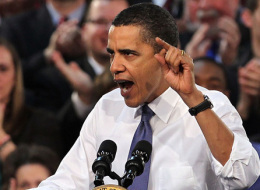
 WASHINGTON (AP)-- Even with victory in hand, President Barack Obama can't put health care to rest.
He still has to sell skeptical Americans on the benefits he claims for the massive overhaul Congress finally approved – and try to save the political skins of fellow Democrats who put their jobs in jeopardy by voting with him.
The White House's chief goal after the health care debate was to be a change in focus to jobs measures and populist issues – intended to be music to the ears of Americans suffering from high unemployment and a limping economic recovery. That's still the case, but the health overhaul is bound to be a major issue through the November elections and beyond.
Despite the year of caustic debate, Obama emerges with a stronger hand.
He's moved on from Phase One of his presidency – stalled. Now he's on to Phase Two – buoyed.
The cliffhanger House vote that approved the overhaul is one of those presidential achievements with multiple side benefits: fresh clout in a capital that worships winners, bragging rights on a key promise kept, and a history-making, country-changing one at that, praise for presidential perseverance against daunting odds, a respite from talk of a mired presidency.
It was news so good that Obama invited dozens of aides to the Truman Balcony for an after-midnight champagne celebration. Senior adviser David Axelrod said Obama was the happiest he'd seen his boss since Election Night when he won the White House – perhaps even happier. "Elections just give you the chance to do things," Axelrod recalled a jubilant Obama saying. "This is the real thing."
How much it will help during the rest of his term, though, is a bit murky. One clue will be found as the president's campaign-related travel schedule unfolds over the months until this fall's congressional elections.
Standing by his promise to provide political cover for those who helped him on health care is about more than keeping his word. If Obama were to see the Democratic congressional majority ended or severely diminished in November, it could make it much harder to push legislation through Congress.
Most of those who could suffer from their "yes" votes are moderate Democrats in conservative-leaning districts and states. Siding with Obama were 17 Democrats who are seeking re-election in districts that Republican John McCain won in 2008, including top GOP targets such as Tom Perriello in Virginia, Betsey Markey in Colorado, Harry Mitchell in Arizona and Suzanne Kosmas in Florida. One other moderate Democrat running a difficult race for the Senate in a right-tilting state – Brad Ellsworth in Indiana – voted for the measure, too.
One question is how much these in-danger Democrats could benefit from Obama's help.
His fundraising prowess will be welcomed by nearly all, and it can take place in the background, far from the candidates' districts if need be. His history of inspiring grass-roots supporters and bringing new voters to the polls will be helpful, too, in some places, though harder to apply in congressional races than in his own White House bid.
There still will be some Democrats who will not want a direct, in-person appeal to voters from a president with job approval ratings hovering around 50 percent.
Another health care task that won't disappear any time soon for Obama is pushing back against Republicans. GOP leaders have made clear they will use any tactic available – at the polls, in Congress and in the courts – to try to punish Democrats for the legislation and to undo it. Aides say Obama plans to aggressively engage the GOP's universal opposition to the bill and efforts to repeal it.
Where the president probably can make the most headway on both offense and defense is with the public.
Polls show people are split over whether they like the bill. So, Obama will seek to improve those numbers, starting with an appearance Thursday in Iowa City, Iowa, and a series of outside-the-Beltway health care-focused events that White House communications director Dan Pfeiffer said would come "periodically" – not daily or even weekly, but regularly though the end of the year.
White House advisers believe there's plenty of time before November to make the bill's benefits real for voters, especially the few parts that take effect soon, among them rebate checks for seniors affected by the Medicare drug coverage gap, permission for children to stay on their parents' health plans until age 26, and bans on insurers turning away children with medical problems or setting lifetime coverage limits.
They also believe that GOP gripes about legislative procedures used by Democrats will fade to a distant memory.
And, Pfeiffer said, "It is helpful for health care reform to go from the theoretical to something real."
The sales job is hardly a slam dunk.
The gigantic bill remakes the nation's health care system – one-sixth of the economy – in a way feared by some as an overly huge and expensive government intrusion.
The changes will come gradually, with some not fully phased in for a decade. Some of the biggest shifts, for instance, such as mandates for most Americans to carry insurance, new places to buy it and new employer obligations, and a ban on denying coverage to the sick, are four years off.
Explaining what happens when, which hardly fits on a legal pad much less a bumper sticker, will not come easily when the target audience is an angry public with a short attention span.
"He knows that the legislative process has been confusing, that it's taken a long time," White House health reform director Nancy-Ann DeParle said.
Legislatively, Obama's approach for the rest of the year was largely set no matter health care's outcome, starting with a steady diet of jobs- and small business-related votes.
He'll also press for action on populist-leaning measures with broad appeal, such as tougher financial industry regulations and rolling back a recent Supreme Court ruling that allows unions and corporations to funnel unlimited dollars to political campaigns.
Even those measures are tough lifts, though, with potentially large partisan opposition. And with the November elections looming, the window for congressional action on anything, much less something else big and controversial, is fast closing.
Also. ...
Across the street from the Capitol, there's the strong expectation of another Supreme Court vacancy. That would steal the remaining oxygen from any legislative issue.
Love her or hate her, health care reform hero Nancy Pelosi is 'Lyndon Johnson in a skirt'
Thomas M. Defrank and Kenneth R. BazinetTuesday, March 23rd 2010, 4:00 AM

Wong/GettyNancy Pelosi gets a big hand from House members after signing the Senate health care reform bill on Monday.
WASHINGTON - Those who know Nancy Pelosi best say without her, President Obama wouldn't have been able to pop open the champagne bottle over his momentous health care win.
Pelosi loves quoting legendary House Speaker Tip O'Neill, and her fans say she's now in the same league as the Democratic lion of the House.
"This has been a remarkable string of victories. Sometimes you look down the field and say, 'How is she going to pull this one off?' And the next thing you know she scores," said Rep. Anthony Weiner (D-Brooklyn).
"The real story here is how Nancy Pelosi dragged Harry Reid and Barack Obama over the finish line," he added.
Asked in an ABC interview Monday if she's the "most powerful woman in 100 years," Pelosi paused, then smiled, "That sounds good."
Even fervent Obama boosters concede Pelosi's clear-eyed commitment to liberal reform, steely determination and tenacity in whipping nervous Democrats into line made the difference between ignominious failure and victory.
"She's Lyndon Johnson in a skirt," Democratic political strategist Mark Siegel said of the San Francisco grandmother, who turns 70 Friday. "She was patient, tireless, persistent and cajoling - and she pulled off what no one else could."
Rep. Joe Crowley (D-Queens) thinks her work ethic and strategic vision top all her attributes. "I can't think of a smarter person on policy or politics," he said. "And I've never seen anyone work as hard at it as she does at both."
Long before Obama gave Rep. Dennis Kucinich (D-Ohio) a ride on Air Force One, Pelosi made a strong gesture for his vote by allowing three hours of debate on a resolution to end the war in Afghanistan.
She also waited out pro-life colleague Bart Stupak of Michigan, knowing he had gone too far out on a limb and would cave and ultimately vote yes.
"She said, 'We're not negotiating,' and she let him hang out there alone for a while. She knew he would come around," said a leadership source.
If she feels burned or insulted, beware. Rep. Steve Lynch (D-Mass.) recently made a dismissive comment that angered Pelosi, whose dad was a machine-pol mayor of Baltimore.
"The speaker doesn't tolerate nonsense," said a lawmaker familiar with the exchange. "I wouldn't want to be Steve Lynch right now."
Since becoming the first woman speaker four years ago, Pelosi has been a favorite whipping girl of the GOP, a Democratic version of Newt Gingrich. Republicans sneer at her liberal politics and designer outfits.
Today, she's smiling and they're fuming.
Kieran Nicholson and Tom McGhee
The Denver Post
03/23/2010 01:00:00 AM MDT
Updated: 03/23/2010 01:58:32 AM MDT

Colorado State Patrol Trooper David Dolan. (The Denver Post)
A uniformed Colorado State Patrol trooper in a marked patrol car was pulled over Monday and arrested on suspicion of drinking and driving.
Douglas County sheriff's deputies stopped 21-year veteran David Dolan, 48, about 7:05 a.m., after numerous motorists reported a State Patrol car driving erratically on northbound Interstate 25 near Castle Rock.
Dolan was handcuffed and booked into Douglas County Jail on suspicion of DUI, DUI per se and prohibited use of weapons.
Booking information is a public record typically available from Douglas County, But information on Dolan was not provided, and a jail official referred questions to a Sheriff's Office spokeswoman, who did not return calls.
Col. James Wolfinbarger, chief of the State Patrol, said he is "disturbed and upset" by the incident. "Anything that tarnishes our badge disturbs me greatly."
Dolan has been placed on unpaid leave pending the outcome of the criminal investigation. The State Patrol's Internal Affairs division also is investigating.
Once the investigations are complete, Dolan will have an administrative hearing that could lead to penalties up to and including termination.
A woman who answered the telephone listed in Dolan's name said, "No comment," and hung up Monday afternoon.
Dolan is assigned to a unit in Colorado Springs, and his duties include investigating the backgrounds of candidates for the Colorado State Patrol Academy in Golden, Wolfinbarger said.
Although Dolan doesn't work at the academy, that is where he said he was headed when he was stopped, Wolfinbarger said.
"I don't know why he was going there," Wolfinbarger said. "He was not on routine patrol."
After receiving reports of a weaving patrol car, the State Patrol called sheriff's dispatchers asking for assistance in "locating the vehicle and checking on the welfare of the driver," according to a media release from the sheriff's office.
A Douglas County deputy spotted the cruiser on westbound C-470 near South Santa Fe Drive and pulled it over near South Platte Canyon Road, the release said.
"After contacting the driver, who was confirmed to be a Colorado State Trooper in full uniform, he was taken into custody for investigation of driving under the influence of alcohol," the release said.
Although State Patrol officers have been arrested before, Wolfinbarger said he has never seen a trooper arrested for driving drunk while on duty.
"I have never seen anything like this," he said. "We have a 75-year history of combating impaired and drunken driving and are deeply committed to eradicating this senseless crime on our roads."
Read more: http://www.denverpost.com/ci_14735791#ixzz0izbw0T0V
Hungry burglar leaves behind cash, dirty dishes
Monday, March 22, 2010
DEENA YELLIN
North Jersey
STAFF WRITER
HILLSDALE – A hungry burglar invaded Matsu Sushi Grill to cook up a chicken dinner, leaving behind no fingerprints for police but leaving restaurant staff with a pile of dirty dishes.
The ravenous culprit was apparently uninterested in the $200 that was left in the cash register.
“He just wanted food, that’s it,” said an incredulous Detective Robert Francaviglia. “He went in and pulled out a plate, got some chicken out of the freezer, got a rice box and fried up the chicken and rice in the frying pan. After he ate, he left.”
The burglar entered the Broadway Avenue restaurant early Saturday morning by breaking an exhaust fan at the rear of the store and climbing in through the hole, said officials. Nobody saw him enter and nothing else was taken besides the food to make the chicken and rice dinner.
A similar incident occurred in Hillsdale last year at the Kentucky Fried Chicken restaurant in which someone entered, cooked food and left. “It could be related,” said Francaviglia. “It could be a homeless person looking for food.”
Hillsdale officials noted that the borough has a food pantry for needy residents and the borough nurse is on call for those in need of a hot meal.
Mistress told to pay wronged wife $6,000,000: U.S. jury uses 19th-century adultery law to punish lover
Mail Foreign Service
9:02 AM on 22nd March 2010
When Cynthia Shackelford's marriage fell apart, it wasn't her husband she dragged into court.
Using a little-known American law, she sued his mistress for stealing him away.
The lawsuit did not win back her cheating husband, but it did give her a measure of revenge after a jury ordered the mistress to pay her the equivalent of $6million.
Mrs Shackelford, 60, said she gave up her teaching career to raise the couple's two children and support 62-year-old husband Allan's legal career.
Cynthia Shackleford sued Anne Lundquist, left, for stealing her husband, Allan Shackelford, right away from her
And she insisted they were still in love when 49-year-old college administrator Anne Lundquist came along.
'I really loved him and I really thought he loved me,' she said. I had not a clue that Allan would wander. He kept telling me, "Oh, she's just a friend. There's no affair. I love you".'
In her lawsuit, the jilted wife also claimed her husband began having the affair before they separated in 2005.
Following a two-day trial in Greensboro, North Carolina, the jury sided with Mrs Shackelford, making the state's highest award for alienation of affection, criminal conversation - legal jargon for adultery - and intentionally or recklessly causing severe emotional distress.
North Carolina remains one of a handful of states which allow married partners to sue someone they believe is responsible for wrecking a marriage.
Mrs Shackelford said her husband met Miss Lundquist while providing legal services for the local Guildford College private school.
She said: 'We would like for people to respect the sanctity of marriage. We wanted a number high enough that it would keep other people from going after married spouses.'
Miss Lundquist said she planned to appeal against the 'ludicrous' judgment.
She lives with Mr Shackelford in Aurora, New York, but insisted the couple met after his marriage had ended. She said: 'The decision is not based on reality. I certainly don't have that kind of money nor will I ever.'
Miss Lundquist, now dean of students at Wells College in Aurora, said she was not given enough notice to prepare for the hearing and was not represented.
'I'm so caught off guard by everything,' she added, saying that finding that kind of money was 'hysterical'.
Although the Shackelfords separated five years ago, their divorce has not been finalised. More than 200 'alienation of affection' cases are filed in North Carolina each year.
The legislation existed in many U.S. states in the late 19th and early 20th centuries, but has been abolished in all but North Carolina, Hawaii, Illinois, Mississippi, New Mexico and Utah.
Although action does not require proof of extramarital sex, the wronged spouse must show that a love in a marriage was alienated and destroyed by the defendant's 'malicious conduct'.
Mrs Shackelford's lawyer, Will Jordan, admitted that securing the full $6million would be difficult.
But he said: 'I'm hoping we'll collect a substantial sum.
'In addition to just collecting the judgment, there's a certain amount of validation or vindication that goes with having a jury acknowledge that you were done wrong.'
LINK TO PHOTOS
Congress clear historic health care bill, sends it to Obama for his signature
DAVID ESPO
AP Special Correspondent
10:13 PM EST, March 21, 2010
WASHINGTON (AP) — Summoned to success by President Barack Obama, the Democratic-controlled Congress approved historic legislation Sunday night extending health care to tens of millions of uninsured Americans and cracking down on insurance company abuses, a climactic chapter in the century-long quest for near universal coverage.
Widely viewed as dead two months ago, the Senate-passed bill cleared the House on a 219-212 vote. Republicans were unanimous in opposition, joined by 34 dissident Democrats.
Obama watched the vote in the White House's Roosevelt Room with Vice President Joe Biden and about 40 staff aides. When the long sought 216th vote came in — the magic number needed for passage — the room burst into applause and hugs. An exultant president exchanged a high-five with his chief of staff, Rahm Emanuel.
A second, smaller measure — making changes in the first — was lined up for passage later in the evening. It would then go to the Senate, where Democratic leaders said they had the votes to pass it.
The nonpartisan Congressional Budget Office said the legislation awaiting the president's approval would extend coverage to 32 million Americans who lack it, ban insurers from denying coverage on the basis of pre-existing medical conditions and cut deficits by an estimated $138 billion over a decade. If realized, the expansion of coverage would include 95 percent of all eligible individuals under age 65.
For the first time, most Americans would be required to purchase insurance, and face penalties if they refused. Much of the money in the bill would be devoted to subsidies to help families at incomes of up to $88,000 a year pay their premiums.
Far beyond the political ramifications — a concern the president repeatedly insisted he paid no mind — were the sweeping changes the bill held in store for millions of individuals, the insurance companies that would come under tougher control and the health care providers, many of whom would face higher taxes.
Crowds of protesters outside the Capitol shouted "just vote no" in a futile attempt to stop the inevitable taking place inside a House packed with lawmakers and ringed with spectators in the galleries above.
Across hours of debate, House Democrats predicted the larger of the two bills, costing $940 billion over a decade, would rank with other great social legislation of recent decades.
"We will be joining those who established Social Security, Medicare and now, tonight, health care for all Americans, said Speaker Nancy Pelosi, partner to Obama and Senate Majority Leader Harry Reid, D-Nev., in the grueling campaign to pass the legislation.
"This is the civil rights act of the 21st century," added Rep. Jim Clyburn of South Carolina, the top-ranking black member of the House.
Republicans readily agreed the bill would affect everyone in America, but warned repeatedly of the burden imposed by more than $900 billion in tax increases and Medicare cuts combined.
"We have failed to listen to America," said Rep. John Boehner of Ohio, leader of a party that has vowed to carry the fight into the fall's midterm elections for control of Congress.
The measure would also usher in a significant expansion of Medicaid, the federal-state health care program for the poor. Coverage would be required for incomes up to 133 percent of the federal poverty level, $29,327 a year for a family of four. Childless adults would be covered for the first time, starting in 2014.
The insurance industry, which spent millions on advertising trying to block the bill, would come under new federal regulation. They would be forbidden from placing lifetime dollar limits on policies, from denying coverage to children because of pre-existing conditions and from canceling policies when a policyholder becomes ill.
Parents would be able to keep children up to age 26 on their family insurance plans, three years longer than is now the case.
A new high-risk pool would offer coverage to uninsured people with medical problems until 2014, when the coverage expansion would go into high gear.
The final obstacle to passage was cleared a few hours before the vote, when Obama and Democratic leaders reached a compromise with anti-abortion lawmakers whose rebellion had left the outcome in doubt. The president issued an executive order pledging that no federal funds would be used for elective abortion, satisfying Rep. Bart Stupak of Michigan and a handful of like-minded lawmakers.
A spokesman for the U.S. Conference of Catholic Bishops expressed skepticism that the presidential order would satisfy the church's objections.
For the president, the events capped an 18-day stretch in which he traveled to four states and lobbied more than 60 wavering lawmakers in person or by phone to secure passage of his signature domestic issue. According to some who met with him, he warned that the bill's demise could cripple his still-young presidency.
After more than a year of political combat, Democrats piled superlative upon superlative across several hours of House debate.
Rep. Louise Slaughter of New York read a message President Franklin Roosevelt sent Congress in 1939 urging lawmakers to address the needs of those without health care, and said Democrat Harry Truman and Republican Richard Nixon had also sought to broaden insurance coverage.
Republicans attacked the bill without let-up, warning it would harm the economy while mandating a government takeover of the health care system.
"The American people know you can't reduce health care costs by spending $1 trillion or raising taxes by more than one-half trillion dollars. The American people know that you cannot cut Medicare by over one-half trillion dollars without hurting seniors," said Rep. Dave Camp, R-Mich.
"And, the American people know that you can't create an entirely new government entitlement program without exploding spending and the deficit."
Obama has said often that presidents of both parties have tried without success to achieve national health insurance, beginning with Theodore Roosevelt early in the 20th century.
The 44th president's quest to succeed where others have failed seemed at a dead end two months ago, when Republicans won a special election for a Massachusetts Senate seat, and with it, the votes to prevent a final vote.
But the White House, Pelosi and Reid soon came up with a rescue plan that required the House to approve the Senate-passed measure despite opposition to many of its provisions, then have both houses pass a fix-it measure incorporating numerous changes.
To pay for the changes, the legislation includes more than $400 billion in higher taxes over a decade, roughly half of it from a new Medicare payroll tax on individuals with incomes over $200,000 and couples over $250,000. A new excise tax on high-cost insurance policies was significantly scaled back in deference to complaints from organized labor.
In addition, the bills cut more than $500 billion from planned payments to hospitals, nursing homes, hospices and other providers that treat Medicare patients. An estimated $200 billion would reduce planned subsidies to insurance companies that offer a private alternative to traditional Medicare.
The insurance industry warned that seniors would face sharply higher premiums as a result, and the Congressional Budget Office said many would return to traditional Medicare as a result.
The subsidies are higher than those for seniors on traditional Medicare, a difference that critics complain is wasteful, but insurance industry officials argue goes into expanded benefits.