
- Home
- Premium Memberships
- Lottery Results
- Forums
- Predictions
- Lottery Post Videos
- News
- Search Drawings
- Search Lottery Post
- Lottery Systems
- Lottery Charts
- Lottery Wheels
- Worldwide Jackpots
- Quick Picks
- On This Day in History
- Blogs
- Online Games
- Premium Features
- Contact Us
- Whitelist Lottery Post
- Rules
- Lottery Book Store
- Lottery Post Gift Shop


The time is now 11:15 pm
You last visited
June 5, 2026, 12:00 pm
All times shown are
Eastern Time (GMT-5:00)

Ultra-34 P-3-P-4 softwarePrev TopicNext Topic
-
I didn't get anywhere tonight. Keep producing the last draw. Unable to provide a screen shot for some reason so anyone can take a peek at my layout. Just when I thought I had it going.

J17 - I have done everything I can think of from CTRL+V or C to copy/paste and even CTRL+PRT SCRN. I changed browsers which now lets me paste text. Doesn't like M Edge.

-
-
-
J17
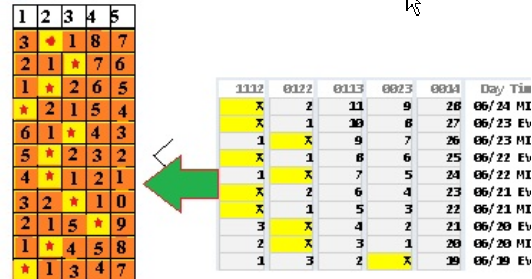
There are 40 codes total which would take up a lot of real-estate, your picture shows a run
of hits for the codes 1112 and 0122 but there are 38 other codes that will in time break up
the distribution. The (P) option shows a list of all 40 + the number of shows and the skips
for each.
The program does include a run-from-file mode option but it's disabled due to lack of button
space. It requires a button to first select the source file then another to run it. I also thought
it would be confusing for some as not everyone has the same level of computer skills. I try to
keep things as simple as I can to avoid the time it takes to support these tools. It's just me on
this end and time is a major factor.
In some of the tools I have posted in the past I included the option to just keep a single database
and included another option that allowed the user to split it as needed. This required a algorithm
that had to calculate several variables before splitting them. This was no little task as some states
have up to four drawings each day. If the user forgot to update a draw or only wanted to update
say, the first two drawings it required a special databases. Winsum provides all the databases for
the tools I upload which without him none of this would be possible.
I never accept offers of payment for my software and believe me I have had some tempting offers.
One was in the $$$$ thousands.
What you suggest I add would not provide any useful data. When I first build a project around some
idea I test the data for predictability. I have a number of tools that test for patterns and what not
but even when patterns are detected they are not dependable. The game may not be truly random
but it's random enough to prevent us from what you suggest. The bottom line IMHO is that while it's
interesting to look at, it not Practicable.
The second filter you mention seems to be aimed at the 4-digit codes. The line generator is rogue
based and the codes are applied like a filter. To do this would mean expanding the code cells so that
more than one value could be entered. It's possible but would require a major rewrite of the batch
tool which is not something I feel would be worth it. Lets say that we allow 2 digits in each cell. If we
place 2 values in the zeros position then the lines generated would double. If we put 2 values in two
of the cells then the lines generated would increase by a factor of 4.
I know adding these sort of things looks tempting but let me assure you there are reasons behind every
choice I make. In pick-3 we have 5-rogue cells and anytime we place 2 values in each cell, ie, 50% of the
total choices, the program will generate 32 lines. The filters provided can easily reduce 32 lines to any
play budget. If we add a third choice to one of the 5 cells then 64 lines are generated which is still doable
when it comes to filtering.
This is my advice, while there is no way to predict the rogue values with 100% certainty they can be a
efficient means to win. Don't over analyze the data as that's never a good idea. I can make a case for
all 4 values most analysis but playing all 4 is not a option. At times our choices will be nothing more than
a best guess. We always have the option to make more than one best guess if that's what it takes but
the more values we put into play the more filtering that will be needed and filtering comes with its own odds.
Consider this, if we set the first 3 rogues to single values and let the other 2 run wild the program will
generate 16 lines and if our choices are correct, produce a straight hit. Each rogue value has a 25%
chance of showing in the next game. Most games, my analysis gives me 3 of the 5 when setting them
to single values but I never know which 3 are correct until after the draw. My solution is to set all 5 to
single values and then swap out two or three with different values and run again. I do my swapping on
paper and build maybe 5 to 10 rogue strings and run them one at a time. I don't always do this and
switch things up quite often using different types of setups. The analysis tools provided are a bit boring
but they will give up the correct values time to time. Here where I live p-3 pays $600 for a straight.
Anytime I can predict and set just one of the 5 rogues to a single value and let the other 4 run wild then
the program will produce a straight and often times several box hits in <= 256 lines. $600-256=$344.
RL
....
-
-
....
-
-
-
There is nothing wrong with being kind to others. But everything is wrong when the respect is not there...
-
Does that mean I have to purchase a membership for access to the positioning wheel? BOOMER!!! Everybody is wanting to charge-no fare!

J17, did you have to purchase too?
There is nothing wrong with being kind to others. But everything is wrong when the respect is not there...
-
-
There is nothing wrong with being kind to others. But everything is wrong when the respect is not there...
-
-
There is nothing wrong with being kind to others. But everything is wrong when the respect is not there...
-