LiLSpeedy's Blog

Today In American History

Jack Johnson
Jack Johnson1.jpg
Statistics
Real name John Arthur Johnson
Nickname(s) Galveston Giant
Rated at Heavyweight
Height 6 ft 2 in (1.88 m)
Reach 74 in (188 cm)
Nationality American
Born (1878-03-31)March 31, 1878 Galveston, Texas
Died June 10, 1946(1946-06-10) (aged 68) Raleigh, North Carolina
Stance Orthodox
Boxing record
Total fights 94
Wins 54
Wins by KO 35
Losses 11
Draws 8
No contests ??


John Arthur "Jack" Johnson (March 31, 1878 – June 10, 1946), nicknamed the Galveston Giant was an American boxer, who—at the height of the Jim Crow era—became the first African American world heavyweight boxing champion (1908–1915). Johnson was faced with much controversy when he was charged with violating the Mann Act in 1912 even though there was an obvious lack of evidence and was largely racially based. In a documentary about his life, Ken Burns notes that "for more than thirteen years, Jack Johnson was the most famous and the most notorious African-American on Earth.

US Flag

Entry #311

Who Is Black?

There are those among us that like to categorize blacks using the obscene one-drop rule. In their mind one is not considered Black if they are of mixed races. But in reality no race in America is 100%. Where did this one-drop rule originate?

One-drop rule

Since the late nineteenth century, the South used a colloquial term, the one-drop rule, to classify as black a person of any known African ancestry. This practice of hypodescent was not put into law until the early twentieth century. Legally the definition varied from state to state. Racial definition was more flexible in the eighteenth and nineteenth centuries before the American Civil War. For instance, President Thomas Jefferson held persons who were legally white (less than 25% black) according to Virginia law at the time, but, because they were born to slave mothers, they were born into slavery, according to the principle of partus sequitur ventrem, which Virginia adopted into law in 1662.

Outside of the US, some other countries have adopted the one-drop rule, but the definition of who is black and the extent to which the one-drop "rule" applies varies greatly from country to country.

The one-drop rule may have originated as a means of increasing the number of black slaves and was maintained as an attempt to keep the white race pure. One of the results of the one-drop rule was the uniting of the African-American community. Some of the most prominent abolitionists and civil-rights activists of the nineteenth century were multiracial, such as Frederick Douglass, Robert Purvis, and James Mercer Langston. They advocated equality for all.

Genetics is what determines race. Virtually everyone has a pigment called melanin that determines skin color. However, it is a person's genes that determine how much melanin is actually presented in skin cells. Those with a lot of melanin in their cells will have very dark skin and those with little will have light colored skin. It is the genetic code in human DNA that also determines their facial features, hair color, etc. It is asinine to try and categorize a person using percentages. To do so would demonstrate a lack of intelligence as well as a very limited science background.

Entry #310

Today In American History

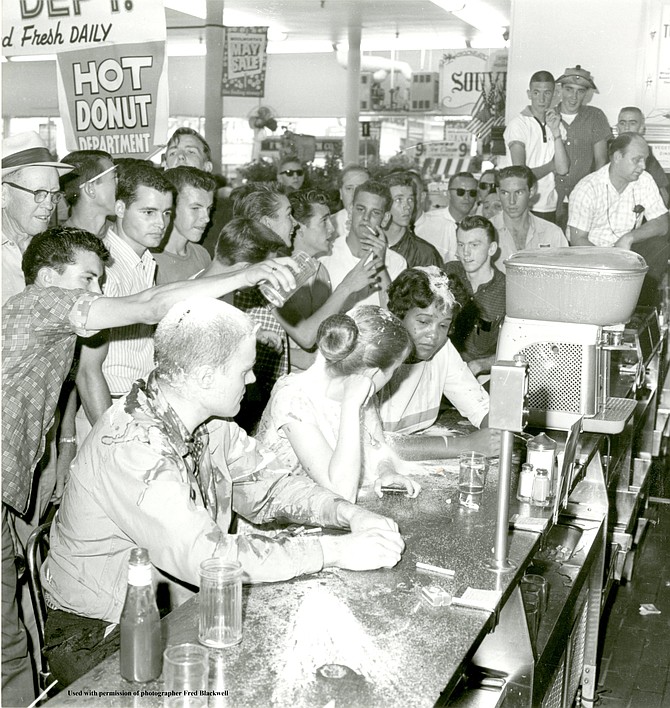
The counter at Woolworth's on May 28, 1963.

Woolworth sit-in, Jackson, MS. May 28, 1963

In sit-ins, protesters usually seat themselves at a strategic location (inside a restaurant, in a street to block it, in a government or corporate office, and so on). They remain until they are evicted, usually by force, or arrested, or until their requests have been met. Sit-ins have historically been a highly successful form of protest because they cause disruption that draws attention to the protest and by proxy the protesters' cause. They are a non-violent way to effectually shut down an area or business. The forced removal of protesters, and sometimes the use of violence against them, often arouses sympathy from the public, increasing the chances of the demonstrators reaching their audience.

Sit-ins were an integral part of the nonviolent strategy of civil disobedience and mass protests that eventually led to passage of the Civil Rights Act of 1964 which ended legally-sanctioned racial segregation in the United States and also passage of the Voting Rights Act of 1965 that struck down many racially-motivated barriers used to deny voting rights to non-whites.

US Flag

Entry #309

Today In American History

The Tuskegee airmen were the first black servicemen to serve as military aviators in the U.S. armed forces, flying with distinction during World War II. Though subject to racial discrimination both at home and abroad, the 996 pilots and more than 15,000 ground personnel who served with the all-black units would be credited with some 15,500 combat sorties and earn over 150 Distinguished Flying Crosses for their achievements. The highly publicized successes of the Tuskegee Airmen helped pave the way for the eventual integration of the U.S. armed forces under President Harry Truman in 1948.


US Flag

Entry #307

Today In American History

Quincy Jones

Quincy Delight Jones Jr. (born March 14, 1933) is an American music impresario, musical arranger, record producer, and film composer.                                                                                             

During 50 years in the entertainment industry Jones’ work has earned him more than 70 Grammy Award nominations, more than 25 Grammy Awards, and a Grammy Legends Award in 1991. He is best known as the producer of two of the top-selling records of all time: the album Thriller, by pop icon Michael Jackson, and the charity song “We Are the World”. Also known for work with Frank Sinatra.

In 1968, Jones along with his songwriting partner Bob Russell became the first African-Americans nominated for an Academy Award in the “Best Original Song” category. That same year, he became the first African-American nominated twice in the same year when he was nominated for Best Original Score (for In Cold Blood). Jones is also the first (and so far, only) African-American to be nominated as a producer in the category of Best Picture (in 1986, for The Color Purple). He is also the first African-American to win the Academy’s Jean Hersholt Humanitarian Award, in 1995. He is tied with sound designer Willie D. Burton as the most Oscar-nominated African-American with seven nominations each. 


US Flag 

Entry #306

Today In American History

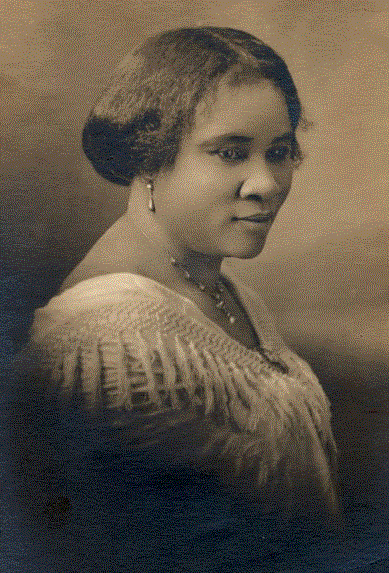
Madame CJ Walker.gif

Sarah Breedlove (December 23, 1867 – May 25, 1919), known as Madam C. J. Walker, was an American entrepreneur and philanthropist, regarded as the first female self-made millionaire in America. She made her fortune by developing and marketing a successful line of beauty and hair products for black women under the company she founded, Madam C. J. Walker Manufacturing Company.

Sarah Breedlove was born on December 23, 1867 in Delta, Louisiana to Owen and Minerva Breedlove. She was one of six children; she had a sister Louvenia and four brothers: Alexander, James, Solomon, and Owen Jr. Her parents and elder siblings were slaves on Madison Parish plantation owned by Robert W. Burney.[1] She was the first child in her family born into freedom after the Emancipation Proclamation was signed. Her mother died, possibly from cholera, in 1872. Her father remarried and died shortly afterward.[2]

Sarah moved in with her older sister and brother-in-law, Willie Powell. At the age of 14, she married Moses McWilliams to escape Powell's mistreatment and three years later her daughter, Lelia McWilliams (A'Lelia Walker) was born. When Sarah was 20, her husband died, and Lelia was just 2 years old. Shortly afterward she moved to St. Louis where three of her brothers lived. They were all barbers at a local barbershop. In 1906 she married Charles Joseph Walker, a newspaper advertising salesman.

Sarah, now known as Madam C. J. Walker, was selling her products throughout the United States. While her daughter Lelia (later known as A'Lelia Walker) ran a mail order business from Denver, Madam Walker and her husband traveled throughout the southern and eastern states. They settled in Pittsburgh in 1908 and opened Lelia College to train "hair culturists." In 1910 Walker moved to Indianapolis where she established her headquarters and built a factory.

She began to teach and train other black women in order to help them build their own businesses. She also gave other lectures on the political, economic and social issues at conventions sponsored by powerful black institutions. After the East St. Louis Race Riot, she joined leaders of the National Association for the Advancement of Colored People (NAACP) in their efforts to support legislation to make lynching a federal crime. In 1918 at the biennial convention of the National Association Of Colored Woman (NACW) she was acknowledged for making the largest contribution to save the Anacostia (Washington, DC) house of abolitionist Frederick Douglass. She continued to donate money throughout her career to the NAACP, the YMCA, and to black schools, organizations, individuals, orphanages, and retirement homes.

The grave of Madam C. J. Walker

In 1917, she moved to her Irvington-on-Hudson, New York estate, Villa Lewaro,[3] which had been designed by Vertner Tandy, the first licensed black architect in New York State and a founding member of Alpha Phi Alpha fraternity. The house cost $250,000 to build.[3] Madam C. J. Walker died at Villa Lewaro on Sunday, May 25, 1919 from complications of hypertension. She was 51. At her death she was considered to be the wealthiest African-American woman in America and known to be the first self-made female American millionaire. Her daughter, A'Lelia Walker, became the president of the Madam C.J Walker Manufacturing Company.

Madam Walker was inducted into the Junior Achievement U.S. Business Hall of Fame at the Museum of Science and Industry in Chicago in 1990, the National Women's Hall of Fame,[4] in Seneca Falls, New York, the National Cosmetology Hall of Fame and the National Direct Sales Hall of Fame. On January 28, 1998, the USPS, as part of its Black Heritage Series, issued the Madam C. J. Walker Commemorative stamp.[5] On March 16, 2010, Congressman Charles Rangel introduced HJ81,[6] a Congressional House Joint Resolution, honoring Madam C. J. Walker. In December 2010, New York Mayor Michael Bloomberg signed a bill designating the block of 136th Street between Malcolm X Boulevard (Lenox Avenue) and Seventh Avenue as Madam Walker and A'Lelia Walker Place.[7]

While according to Walker's New York Times obituary, "she said herself two years ago [in 1917] that she was not yet a millionaire, but hoped to be some time,"[3] the Guinness Book of Records named Walker as the first woman to become a millionaire by her own achievements.


 

US Flag

Entry #305

Today In American History

Charles R Drew portrait.jpg

Charles Richard Drew (June 3, 1904 – April 1, 1950) was an American physician, surgeon, and medical researcher. He researched in the field of blood transfusions, developing improved techniques for blood storage, and applied his expert knowledge to developing large-scale blood banks early in World War II. This allowed medics to save thousands of lives of the Allied forces.[1] The research and development aspect of his blood storage work is disputed.[2] As the most prominent African-American in the field, Drew protested against the practice of racial segregation in the donation of blood, as it lacked scientific foundation, an action which cost him his job.

Drew was born in 1904 into an African-American middle-class family in Washington, D.C. His father, Richard, was a carpet layer[3] and his mother, Nora Burrell, was a teacher. Drew and his siblings grew up in DC's Foggy Bottom neighborhood[4] and he graduated from Dunbar High School in 1922.[5] Drew won an athletics scholarship to Amherst College in Massachusetts,[6] where he graduated in 1926.[7] An outstanding athlete at Amherst,[8] Drew also joined Omega Psi Phi fraternity.[9] He attended medical school at McGill University in Montreal, Canada, receiving his M.D. in 1933 as well as a Master of Surgery degree,[7] and ranked 2nd in his class of 127 students.[7] A few years later, Drew did graduate work at Columbia University, where he earned his Doctor of Medical Science degree, becoming the first African American to do so.[7]

In late 1940, before the US entered World War II and just after earning his doctorate, Drew was recruited by John Scudder to help set up and administer an early prototype program for blood storage and preservation. He was to collect, test, and transport large quantities of blood plasma for distribution in Great Britain.[11] Drew went to New York to direct the United States' Blood for Britain project. The Blood for Britain project was a project to aid British soldiers and civilians by giving US blood to Great Britain.

Drew created a central location for the blood collection process where donors could go to give blood. He made sure all blood plasma was tested before it was shipped out. He ensured that only skilled personnel handled blood plasma to avoid the possibility of contamination. The Blood for Britain program operated successfully for five months, with total collections of almost 15,000 people donating blood, and with over 5,500 vials of blood plasma.[11] As a result, the Blood Transfusion Betterment Association applauded Drew for his work. Out of his work came the American Red Cross Blood Bank.

From 1435, Drew attended the annual free clinic at the John A. Andrew Memorial Hospital in Tuskegee, Alabama. For the 1950 Tuskegee clinic, Drew and three other black physicians decided to drive rather than fly. Drew was driving around 8 a.m. on April 1. Still fatigued from spending the night before in the operating theater, Drew lost control of the vehicle. After careening into a field, the car somersaulted three times. The three other physicians suffered minor injuries. Drew was trapped with serious wounds; his foot had become wedged beneath the brake pedal. When reached by emergency technicians, Drew was in shock and barely alive due to severe leg injuries. Drew was taken to Alamance General Hospital in Burlington, North Carolina. He was pronounced dead a half hour after he first received medical attention. Drew's funeral was held on April 5, 1950, at the Nineteenth Street Baptist Church in Washington,DC.


US Flag

Entry #304

Today In American History

John Albert Burr patented the rotary-blade lawn mower.
 
By Mary Bellis       

On May 9, 1899, John Albert Burr patented an improved rotary blade lawn mower. Burr designed a lawn mower with traction wheels and a rotary blade that was designed to not easily get plugged up from lawn clippings. John Albert Burr also improved the design of lawn mowers by making it possible to mow closer to building and wall edges. You can view U.S. patent 624,749 issued to John Albert Burr below.

John Albert Burr - patent for the first rotary-blade lawn mower

Entry #302

Today In American History

Percy Julian 1899 – 1975

Percy Lavon Julian was born in Alabama as the eldest of six children. His father, James Sumner Julian, was a slave and he grew up during the time of heightened racism in the US. Among his childhood memories was finding a man lynched while walking in some woods near his home.

Julian's parents steered all their children towards education and he eventually studied at DePauw University in Indiana, which accepted African American students. He earned an Austin Fellowship in Chemistry and went to Harvard University in 1923, but the institution worried that white students would dislike being taught by a black person, so withdrew his teaching assistantship meaning he could not complete his PhD.

He later received a Rockefeller Foundation fellowship and was able to obtain his PhD at the University of Vienna in 1931.

Julian became a research chemist and pioneered the chemical synthesis of medical drugs from plants, becoming the first to create the large-scale synthesis of hormones such as testosterone, steroids and progesterone.

He went on to start his own company, where he worked to reduce the cost of producing steroids, meaning more people could access them for medical problems. Julian was only the second African American to be inducted into the National Academy of Sciences and was one of the first to receive a doctorate in chemistry.


US Flag


Entry #300